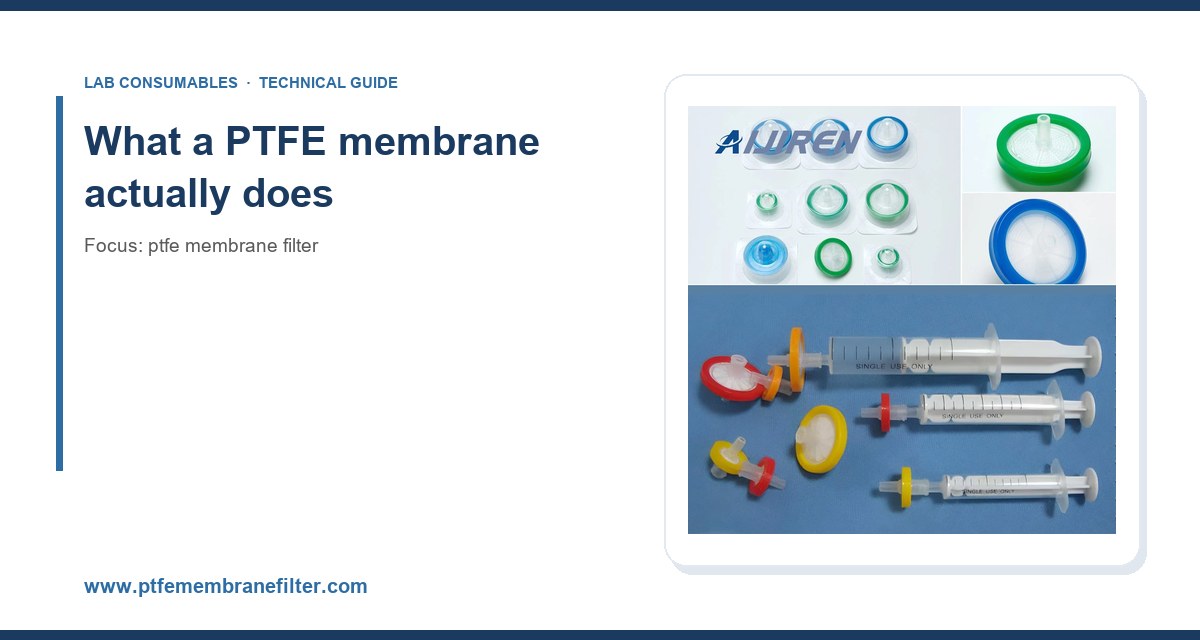
I have watched a postdoc ruin a 40-sample pesticide panel by pulling the wrong filter out of the drawer. The membrane was a 0.45 µm nylon disc, fine for aqueous buffers, but the samples were in 90:10 hexane:acetone. The nylon swelled, shed a little polymer, and every chromatogram came back with a baseline drift and three ghost peaks that nobody could identify until we ran a blank. That afternoon cost us a week. The fix was a PTFE membrane filter, 13 mm, 0.2 µm, hydrophobic, in a polypropylene housing. The lesson is not that PTFE is magic. The lesson is that filter selection is a specification exercise, and if you do not run it deliberately you will run it by accident.
This guide is the one I wish someone had handed me in 2009. It covers membrane chemistry, pore size, diameter, housing material, hold-up volume, pressure and temperature limits, chemical compatibility, extractables, and the small operational details (torque, puncture counts, wetting) that decide whether your data holds up under audit.
Polytetrafluoroethylene is a fully fluorinated polymer. The carbon backbone is wrapped in fluorine atoms, which is why it has essentially no dipole moment and no hydrogen-bonding sites. That structure gives you three things that matter in a lab: near-universal chemical inertness, very low surface energy (around 18 to 20 mN/m), and thermal stability up to 260 °C continuous in air for sintered grades.
In filtration, PTFE is supplied in two forms that behave very differently:
- Unlaminated (unsupported) PTFE. A pure PTFE sheet, typically 20 to 100 µm thick. It is the most chemically resistant option but it is soft, creeps under load, and is hard to handle below about 25 mm diameter. You see it in vent filters and in aggressive-solvent applications where nothing else survives.
- Laminated (supported) PTFE. A thin PTFE layer (often 5 to 20 µm) bonded to a polypropylene or polyethylene backing. The backing provides mechanical strength; the PTFE provides the chemistry. This is what most syringe filters and capsule filters use, and it is what you should default to for HPLC and GC sample prep.
The pore structure is created by stretching or by a proprietary casting process, giving a web of fibrils with a defined pore size. Nominal ratings are usually 0.2 µm, 0.45 µm, 1.0 µm, and 5.0 µm. Note the word nominal: pore size is a distribution, not a single number, and a 0.45 µm filter will pass some particles larger than 0.45 µm. If you need absolute retention, ask for a bubble-point specification, not a nominal rating.
Selection criteria, in the order I actually apply them
Most buyers start with diameter and work backward. I start with chemistry and work forward. The order matters because a filter that is chemically wrong is wrong at every size.
1. Chemical compatibility of the sample and the mobile phase
PTFE is compatible with almost everything you will put through it: concentrated acids (except molten alkali metals and fluorine at elevated temperature), strong bases, ketones, esters, chlorinated solvents, THF, DMSO, DMF, and most aqueous buffers. That is the headline. The real question is compatibility of the housing and the support layer, not the membrane.
Most syringe filter housings are polypropylene (PP). PP is good to about 100 °C and resists most solvents, but it will swell and soften in prolonged contact with DCM, THF, and some aromatics. Acrylic housings are cheaper and optically clear but fail badly in ketones and chlorinated solvents. If you are filtering DCM or THF, specify an all-PTFE or PTFE-on-PP housing rated for short contact, and do not leave the filter sitting in solvent overnight.
For GC work, remember that the filter is upstream of the inlet. Any plasticizer or oligomer that leaches from the housing lands on your column. I have seen phthalate peaks appear at retention times matching DEHP after a batch of samples was filtered through cheap acrylic housings. If your method has a low-level plasticizer target, buy the certified low-extractable grade and run a solvent blank through the filter before you trust it.
2. Pore size: 0.45 µm versus 0.2 µm
The default for HPLC sample prep is 0.45 µm. It removes the particles that clog frits and column inlets, and it does not strip analytes or slow you down unnecessarily. Use 0.2 µm when:
- You are doing sterile filtration or bioburden control.
- You are filtering a sample that will sit in an autosampler for more than 24 hours and you want to slow microbial growth.
- Your column has a 2.1 mm or 1.0 mm internal diameter and a sub-2 µm particle bed. Small-bore columns are far less tolerant of fines, and 0.2 µm is cheap insurance.
- You are preparing samples for LC-MS and want to reduce the chance of a particle reaching the MS source.
Do not go to 0.1 µm unless you have a specific need. Hold-up volume rises, flow rate drops, and for most reversed-phase work you gain nothing. If you are filtering a viscous sample like a lipid extract, 0.45 µm may already be slow; consider a 1.0 µm prefilter in line or a larger diameter.
3. Diameter and hold-up volume
Diameter is a trade-off between sample loss and throughput. Here are the numbers I use in training:
- 4 mm syringe filter: hold-up around 10 to 25 µL. Use only when you have less than 100 µL of sample and cannot afford loss.
- 13 mm: hold-up around 50 to 100 µL. The workhorse for 1 to 5 mL samples in autosampler vials.
- 25 mm: hold-up around 100 to 200 µL. Good for 5 to 50 mL and for samples with moderate particulate load.
- 33 mm and 47 mm: hold-up 300 µL to over 1 mL. For large volumes, vacuum filtration, or solvent degassing.
Hold-up volume is the number that quietly destroys low-volume methods. If you filter 200 µL through a 25 mm filter, you may lose half of it to the housing and the membrane. Match the filter to the sample, not the other way around. For 2 mL autosampler work, 13 mm is almost always right, and the filtrate goes straight into a 2 mL vial with a vial insert if the volume is tight.
4. Hydrophobic versus hydrophilic PTFE
Standard PTFE is hydrophobic. Aqueous samples will not wet it without help. You have three options:
- Pre-wet with a miscible solvent. Flush 1 to 2 mL of methanol or isopropanol through the filter, then flush with your aqueous phase. This is the cheapest route and it works, but it adds a step and a potential contamination source.
- Use hydrophilic PTFE. Modified PTFE (often called hydrophilic PTFE or H-PTFE) wets with water and is the right choice for aqueous samples, buffers, and biological matrices. It costs more and has slightly lower chemical resistance than pure PTFE, but for aqueous work it is the practical answer.
- Use a different membrane chemistry. If your sample is purely aqueous and you do not need PTFE’s solvent resistance, a PES or PVDF filter may be cheaper and faster. PTFE earns its price in aggressive solvents and in venting applications, not in plain water.
5. Temperature and pressure ratings
For syringe filters, the housing rating is the limiting factor. Typical PP housings are rated to 100 °C and 5 to 7 bar (70 to 100 psi) burst. That is plenty for manual syringe work, which rarely exceeds 2 to 3 bar. If you are filtering hot solutions or using a pressure-driven manifold, check the rating on the datasheet, not on the box.
For capsule and disc filters used in-line, PTFE membranes themselves handle 260 °C, but the housing and seals decide the real limit. Silicone seals are good to about 200 °C; PTFE-encapsulated O-rings go higher. If you are autoclaving, confirm the housing is rated for steam at 121 °C for 15 to 20 minutes and that the membrane is not laminated with a backing that delaminates under repeated cycles.
6. Extractables and leachables
This is where cheap filters cost you the most. Every filter contributes something to the filtrate: membrane fines, housing oligomers, mold release agents, and wetting agents. For trace analysis (ppb and low ppm), specify a filter with a documented extractables profile and a low UV absorbance at your detection wavelength. A simple test is to filter HPLC-grade water or your mobile phase through a fresh filter and inject it as a blank. If you see peaks above your method’s limit of detection, the filter is the problem.
For regulated work, USP <665> and the ICH Q3D elemental impurity guidance are the references to cite. For environmental work, the method itself often specifies the filter; check U.S. EPA SW-846 before you substitute anything.
Comparison checklist: matching filter to workflow
Here is the table I keep taped inside the sample prep cabinet. It is not exhaustive, but it covers 90% of the decisions.
- Reversed-phase HPLC, aqueous/organic mobile phase, 2 mL autosampler vials: 13 mm, 0.45 µm, hydrophilic PTFE or PTFE-on-PP, hold-up under 100 µL. Pre-wet if hydrophobic.
- Normal-phase or GC, nonpolar solvent: 13 mm, 0.45 µm, hydrophobic PTFE, PP housing. No pre-wetting needed. Avoid acrylic housings.
- LC-MS, low-level targets: 13 mm, 0.2 µm, low-extractable PTFE, certified. Run a blank through the filter first.
- Aggressive solvents (DCM, THF, DMF): 13 or 25 mm, 0.45 µm, all-PTFE or PTFE-on-PTFE housing. Short contact only.
- Large volume (50 to 500 mL): 47 mm disc or capsule, 0.45 µm, PTFE on PP support, vacuum or pressure driven.
- Gas venting and sterile air: 0.2 µm hydrophobic PTFE, unlaminated, rated to 260 °C. This is the classic vent filter application.
Operational precautions that decide your RSD
The filter is only half the method. How you use it decides whether your %RSD stays under 2% or wanders to 8%.
Syringe selection and torque
Use a syringe with a Luer lock, not a slip tip. A slip tip will pop off under pressure and spray your sample across the bench. For 13 mm filters, a 1 to 3 mL syringe gives good control; for 25 mm, use 5 to 10 mL. Push slowly. A steady 1 to 2 mL per second is fine; a hard shove generates back-pressure, forces fines through the membrane, and can rupture the support layer. I have seen a 0.2 µm PTFE filter pass particles because someone pushed a 10 mL syringe with both thumbs.
When you attach the filter, hand-tighten to about 0.5 to 0.8 N·m. That is snug, not gorilla-tight. Over-torque cracks the housing at the Luer taper and creates a leak path that looks like a membrane failure. Under-torque and the filter weeps at the seal.
Puncture counts and septa
If you are filtering directly into a vial and then sampling with an autosampler, remember the septum. A standard silicone/PTFE septum tolerates roughly 5 to 10 punctures before coring becomes a real risk. If your method reinjects, or if you are running a long sequence with the same vial, use a pre-slit septum or plan to replace the cap. Coring produces silicone particles that land in the vial and show up as spikes in your chromatogram. This is a filter-adjacent problem, but it is the same particle-control discipline.
Wetting and priming
For hydrophobic PTFE with aqueous samples, pre-wet with 1 to 2 mL of methanol or isopropanol, then flush with 1 to 2 mL of the aqueous phase before you collect. Do not skip the flush; the first fraction contains the wetting solvent and will skew your early eluting peaks. If you are using hydrophilic PTFE, a single 1 mL water flush is enough.
Filter placement and dead volume
Keep the filter vertical, outlet down, so air does not get trapped against the membrane. Trapped air reduces effective area and raises back-pressure. If you are filtering into a COD vial or any narrow-mouth container, use a short outlet or a funnel to avoid splashing and cross-contamination.
Troubleshooting checklist
When a filtration step goes wrong, work through this list in order. It is faster than guessing.
- Slow flow or high back-pressure: particulate load too high, pore too small, or sample too viscous. Try a larger diameter, a 1.0 µm prefilter, or dilute the sample.
- Filter ruptures or housing cracks: over-pressure or over-torque. Check the burst rating and hand-tighten to 0.5 to 0.8 N·m.
- Ghost peaks in the chromatogram: extractables from the housing or membrane. Run a solvent blank through a fresh filter and compare. Switch to a low-extractable grade.
- Analyte loss (low recovery): adsorption on the membrane or hold-up in the housing. Use a smaller diameter, a lower hold-up design, or a different membrane chemistry.
- Baseline drift: plasticizer or wetting agent leaching. Confirm with a blank and switch to certified filters.
- Particles still reaching the column: nominal pore size exceeded by fines, or the filter was bypassed at the seal. Check the seal and consider 0.2 µm.
- Inconsistent results across analysts: push rate and pre-wetting differ. Write the step into the SOP with volumes and timings.
What to buy, and from whom
For routine HPLC and GC sample prep, my default recommendation is a 13 mm, 0.45 µm PTFE-on-PP syringe filter with a Luer lock inlet and outlet, hold-up under 100 µL, PP housing rated to 100 °C and 5 bar, and a documented extractables profile. Buy a case of 100 or 500 and keep a second case of 0.2 µm for LC-MS and small-bore columns. For aggressive solvents, keep a small stock of all-PTFE 25 mm filters. For venting, buy unlaminated 0.2 µm hydrophobic PTFE discs rated to 260 °C.
When you compare suppliers, ask for four things in writing: the membrane material and whether it is laminated, the housing polymer, the hold-up volume, and the extractables or UV absorbance data. A supplier who cannot provide all four is selling you a commodity, and commodities are where the ghost peaks come from. The PTFE membrane filter range at ptfemembranefilter.com publishes these specifications, which is the reason I recommend starting there for a like-for-like comparison.
For method development and column selection, the technical resources at Restek and the consumables catalogues from Agilent and Thermo Fisher are worth bookmarking. They publish compatibility tables and particle-retention data that save you a week of trial and error. Cross-check any filter substitution against the method source, whether that is a pharmacopeial monograph, an EPA method, or an internal SOP.
Takeaway
Choosing a PTFE membrane filter is a four-variable problem: chemistry, pore size, diameter, and housing. Get those right and the rest is discipline: pre-wet when you need to, push slowly, torque to 0.5 to 0.8 N·m, run a blank before you trust a new lot, and write the step into the SOP with volumes and timings. The filter is the cheapest component in the workflow and the one most likely to invalidate a run. Treat it like a specification, not an afterthought, and your RSD will stay where it belongs.
References & further reading
Related resources from our lab consumables network:
- Ptfe Membrane Filter at ptfemembranefilter.com
- Cod Vial at codvial.com
- Vial Insert at hplcinsert.com
- 2Ml Vial at 2mlsamplevial.com
External references and standards: