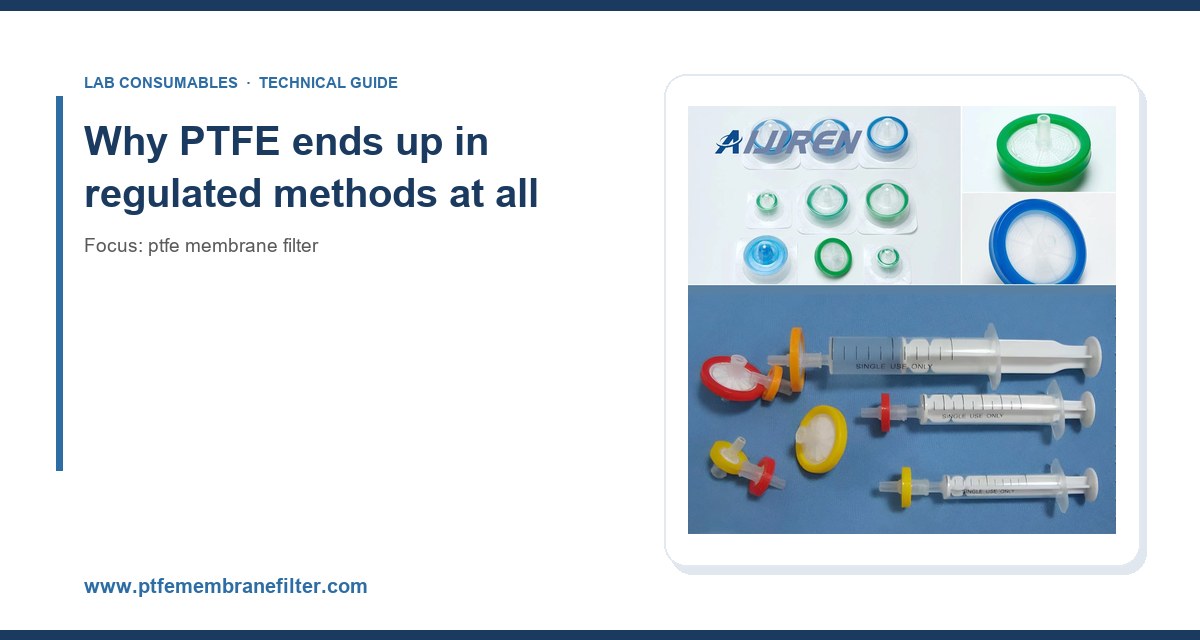
I have watched a validated method fall apart over a filter. The analyst swapped a 0.45 µm PTFE syringe filter for a 0.22 µm cellulose acetate unit because the box was closer to the balance, and the recovery on the semivolatile surrogate dropped from 94% to 61% on the next batch. The calibration was fine. The instrument was fine. The filter was wrong, and nobody had written the filter into the method as a controlled component. That experience shaped how I specify membranes for any regulated work now: the filter is part of the analytical system, and it gets the same scrutiny as the column and the detector.
This article covers what actually matters when PTFE membrane filters sit inside EPA, ISO, and AOAC methods. I will go through the material properties that drive compliance, the specific method families where PTFE is the correct or incorrect choice, the numbers you need on a specification sheet, and a troubleshooting checklist drawn from real batch failures.
Polytetrafluoroethylene is chemically inert to almost everything an analytical lab handles. It resists concentrated acids, bases, strong oxidizers, and the full range of organic solvents used in extraction and mobile phases. That inertness is the reason PTFE shows up in methods where the sample matrix is unknown or aggressive: environmental extracts, waste leachates, pesticide residues in high-fat matrices, and anything coming out of a digestion block.
The second reason is low extractables. A well-manufactured PTFE membrane, particularly one that is unsupported or backed with a polypropylene support rather than a binder-laden matrix, contributes very little to the chromatogram. There is no surfactant leaching, no wetting agent, no binder. For methods pushing detection limits into the low ng/mL range, that matters. I have run filter blanks on PTFE and on mixed cellulose esters side by side, and the difference in total organic carbon and in UV-absorbing extractables at 210 nm is not subtle.
The third reason is temperature and chemical compatibility in the filtration train itself. PTFE membranes hold up to autoclaving and to filtration of hot extracts where other polymers soften or deform.
The material properties that drive compliance decisions
Hydrophobicity and what it means for aqueous samples
Standard PTFE is hydrophobic. Water will not wet it without help. In regulated methods this is either a feature or a problem depending on the sample. For organic extracts, hydrophobic PTFE is ideal: it passes solvent, rejects water, and does not swell. For aqueous samples, you either need a hydrophilic PTFE (surface-modified) or you need to pre-wet the membrane with a small volume of methanol or isopropanol before pushing the aqueous phase through. That pre-wet step has to be in the method, because an analyst who skips it will get a filter that refuses to pass liquid and a sample that gets lost or, worse, diluted with wetting solvent in an uncontrolled way.
I write the pre-wet volume into the SOP explicitly. For a 25 mm disc, 1 to 2 mL of methanol followed by a water rinse is typical. For a 13 mm disc, 0.5 mL is enough. Document it, because auditors ask.
Pore size and the 0.45 vs 0.22 µm question
Most regulated filtration steps specify 0.45 µm for general particulate removal ahead of HPLC or IC, and 0.22 µm when the method also requires sterilization or when particle load is high enough that a 0.45 µm membrane loads up too fast. The choice is not arbitrary. A 0.22 µm membrane will retain more of the sample, including some colloidal material that a 0.45 µm membrane passes. If your method was validated with 0.45 µm and you switch to 0.22 µm, you change the effective sample composition. That is a method change, and in a regulated environment it needs documentation.
Where methods reference sterilization or where bioburden matters, 0.22 µm is the standard. Where the goal is protecting the column from particulates, 0.45 µm is usually sufficient and gives better flow and lower hold-up volume.
Hold-up volume and recovery
Hold-up volume is the sample that stays in the membrane and housing and never reaches your vial. For a 13 mm syringe filter with a 0.45 µm PTFE membrane, hold-up is typically 10 to 25 µL depending on housing design. For a 25 mm unit it climbs to 50 to 100 µL. If you are filtering 1 mL of extract and the method measures a volatile or semivolatile analyte, that hold-up is a real recovery loss, and it is worst for the first fraction through the filter.
The practical fix is to discard the first 0.5 to 1 mL of filtrate, or to use a smaller diameter filter for small volumes. I standardize on 13 mm for anything under 2 mL and reserve 25 mm for larger volumes or dirtier matrices.
Where PTFE is the right call in EPA methods
The U.S. EPA SW-846 test methods cover waste and materials and are the backbone of environmental compliance work. Several of these methods involve extraction of solids and liquids with organic solvents, followed by filtration before instrumental analysis.
SW-846 method families and filtration steps
Methods in the 3500 series (extraction) and 8000 series (chromatographic analysis) frequently call for filtration of the extract before injection. PTFE is the natural membrane choice for these because the extracts are solvent-based. A method like 8270 (semivolatiles by GC/MS) operates on methylene chloride or similar extracts where cellulose-based membranes would swell or dissolve.
What I watch for: the method may specify a filter pore size but not the membrane material. That is a gap you have to close in your SOP. If the method says “filter through a 0.45 µm membrane” and your extract is dichloromethane, a PTFE membrane is the defensible choice because it will not degrade. Document the material selection rationale so an auditor sees the reasoning, not just the part number.
Method 1664 and oil and grease
Method 1664 for oil and grease uses solid-phase extraction and gravimetric determination. Filtration steps here involve aqueous and solvent phases, and membrane choice affects the mass balance. PTFE’s low extractable mass is an advantage in gravimetric work because you are not adding filter-derived mass to the result. I have seen cellulose membranes contribute measurable residue in gravimetric oil and grease work under aggressive drying; PTFE does not.
ISO methods and the international angle
ISO methods often specify filtration more prescriptively than EPA methods, including membrane material. ISO 5667 (water quality sampling) and the ISO 17025 accreditation framework push labs toward documented, traceable consumables. If your PTFE filter is not on a controlled supplier list with a certificate of analysis and a defined lot, you have an accreditation exposure.
What ISO 17025 auditors actually ask about filters
They ask three things. First, is the filter specified in the method or the SOP, including material, pore size, and diameter? Second, is there a supplier qualification record? Third, is there a filter blank or extractables check in the method validation or ongoing quality control? If you cannot answer all three, fix it before the next assessment. The filter is a consumable, but it is a consumable that touches the sample, so it is in scope.
I keep a one-page filter specification sheet for every method that uses filtration, listing membrane material, pore size, diameter, housing material, hold-up volume, and maximum operating temperature. That sheet is what I hand an auditor.
AOAC methods and food and agricultural matrices
AOAC methods cover food, feed, and agricultural products, and the matrices are often fatty, protein-rich, or particulate-heavy. PTFE is useful here for organic extracts and for methods involving solvent partition. For aqueous food extracts, hydrophilic PTFE or a pre-wet step is needed.
The failure mode I see most in food work is filter loading. A fatty extract will blind a 13 mm membrane fast. If the method calls for filtration of a high-fat extract, use a 25 mm or 33 mm membrane, or a glass fiber prefilter ahead of the PTFE, and expect to change the filter mid-batch if the sample is dirty. A blinded filter that an analyst forces through with a syringe creates back-pressure, potential membrane rupture, and particulate carryover into the column. I have pulled shredded PTFE out of an inline filter housing more than once.
Specification sheet: the numbers that matter
Here is the comparison I use when qualifying a PTFE filter for a regulated method. These are the parameters I want on the certificate and on the supplier’s datasheet.
| Parameter | Typical spec | Why it matters in a regulated method |
|---|---|---|
| Membrane material | PTFE, unsupported or PP-backed | Chemical compatibility; extractables profile |
| Pore size | 0.22 µm or 0.45 µm | Particulate retention vs sample loss |
| Diameter | 13, 25, 33, 47 mm | Hold-up volume and loading capacity |
| Housing material | Polypropylene (PP) or acrylic | Solvent compatibility; acrylic fails on ketones and chlorinated solvents |
| Hold-up volume | 10 to 25 µL (13 mm); 50 to 100 µL (25 mm) | Recovery on small volumes |
| Max operating temperature | 100 to 130 °C for PP housing; higher for unsupported PTFE discs | Hot extract filtration; autoclave compatibility |
| Burst pressure | 3 to 6 bar typical for syringe filters | Prevents rupture under syringe pressure |
| Extractables | Gravimetric and UV blank data | Method blank and LOQ impact |
| Sterilization | Autoclavable or gamma-sterilized | 0.22 µm sterilization claims |
Housing material is not a detail
I have seen an analyst run a methylene chloride extract through an acrylic-housed filter because it was the only 0.22 µm unit in the drawer. The housing clouded and softened within seconds. Acrylic is incompatible with chlorinated solvents and ketones. Polypropylene housing is the safe default for organic work. If your method involves dichloromethane, chloroform, acetone, or THF, confirm PP housing before the filter touches the sample.
Puncture counts and physical integrity
For methods that involve septum piercing or inline sampling, PTFE-faced septa and PTFE-lined caps are common. A standard 2 mL vial with a PTFE-faced silicone septum will take a limited number of needle punctures before coring becomes a risk. I plan on no more than 3 to 5 punctures per septum position for GC work, and I rotate positions. Coring produces silicone fragments that end up in the injector and, eventually, on the column. If you are running an autosampler with multiple injections from the same vial, use a fresh septum or a vial designed for it. The 2ml vial you choose should have a septum rated for your puncture count, and the PTFE face should be on the sample side.
Filtration in the sample path: vials, inserts, and the filter interface
Filtration does not end at the syringe filter. The filtrate goes into a vial, and the vial and insert are part of the same compliance chain. If you filter into a 2 mL vial with a low-volume insert, the insert geometry affects how much of your filtered sample actually reaches the needle. A vial insert with a 150 to 250 µL capacity is standard for HPLC work where sample volume is limited. Make sure the insert is compatible with the autosampler and that the PTFE filter did not introduce particles that settle into the insert tip.
For COD and other colorimetric or titrimetric methods, the filtration step protects the measurement from turbidity, and the COD vial you use should be matched to the filtered sample volume and the digestion chemistry. A PTFE filter that sheds particles into a COD vial will read as false turbidity or interfere with the dichromate absorbance.
The core product line, the PTFE membrane filter, is where I start when specifying any of these methods, because the membrane is the component that determines compatibility, extractables, and hold-up. Get the membrane right and the rest of the sample path is easier to control.
Operational precautions that prevent batch failures
Pre-wetting and priming
For hydrophobic PTFE and aqueous samples, pre-wet with 1 to 2 mL methanol for a 25 mm disc, then rinse with the aqueous phase or with water. Do not let the membrane go dry between wetting and filtration. A dry hydrophobic membrane will not pass water no matter how hard you push.
Syringe pressure and flow rate
Push slowly. A syringe filter is not a pressure vessel. Exceeding the burst pressure, typically 3 to 6 bar, risks membrane rupture and particulate carryover. If the filter is hard to push, the membrane is loaded; change it rather than forcing. I tell analysts: if your thumb hurts, stop.
Discarding the first fraction
Discard the first 0.5 to 1 mL of filtrate for small-volume work to avoid hold-up dilution. For a 13 mm filter with 1 mL sample, discarding half the volume is wasteful; use a smaller hold-up filter or accept the recovery loss and document it. The right answer depends on the method’s recovery acceptance criteria.
Filter blanks and extractables checks
Run a filter blank with the same solvent and volume as the sample, at least once per lot, and include it in the method’s ongoing QC. For methods with tight LOQs, a filter blank that shows a peak at the analyte retention time is a red flag. PTFE is low-extractable, but “low” is not “zero,” and lot-to-lot variation exists.
Troubleshooting checklist
When a filtration-related problem shows up in a regulated batch, I work through this list in order.
- Recovery low on small volumes: check hold-up volume and whether the first fraction was discarded. Switch from 25 mm to 13 mm for volumes under 2 mL.
- Filter will not pass aqueous sample: membrane not pre-wet, or you are using hydrophobic PTFE where hydrophilic is needed. Pre-wet with 1 to 2 mL methanol.
- Housing clouded or softened: incompatible housing material. Replace acrylic with PP for chlorinated solvents and ketones.
- Particulates on the column or in the vial: membrane ruptured under pressure, or pore size too large. Check burst pressure and confirm 0.45 µm or 0.22 µm as specified.
- Filter blank shows analyte peak: extractables or contamination. Request a lot-specific blank and consider a different supplier lot.
- Septum coring in GC: too many punctures. Limit to 3 to 5 per position and rotate.
- High back-pressure mid-batch: filter blinded by high particulate load. Add a glass fiber prefilter or use a larger diameter.
- Inconsistent results across analysts: filtration step not written into the SOP with material, pore size, diameter, and pre-wet volume. Fix the SOP.
Instrument and consumable integration
The filter does not operate in isolation. The column, the autosampler, and the vial all interact with it. When I qualify a filtration step, I cross-check against the column manufacturer’s guidance. Agilent chromatography consumables and columns documentation is useful for understanding particle tolerance and inlet requirements, and Thermo Fisher chromatography and sample handling resources cover the sample prep side. For method development and troubleshooting references, Restek technical resources for chromatography are a practical starting point, especially for GC inlet and septum issues that trace back to filtration and vial handling.
Recommendation: how I specify PTFE filters for regulated methods
For most regulated HPLC and GC work with organic extracts, I specify an unsupported or PP-backed PTFE membrane, 0.45 µm pore size, 13 mm diameter for sample volumes under 2 mL and 25 mm for larger or dirtier samples, in a polypropylene housing, with a documented hold-up volume and a lot-specific extractables blank. Maximum operating temperature of 100 to 130 °C covers hot extract filtration; for autoclave or high-temperature work I move to unsupported PTFE discs in a compatible holder.
For aqueous samples, I specify hydrophilic PTFE or write a pre-wet step into the SOP with a defined methanol volume. For sterilization claims, 0.22 µm with gamma or autoclave documentation. For gravimetric methods like oil and grease, PTFE’s low extractable mass is the deciding factor.
The concrete parameters I put on the specification sheet: membrane material, pore size, diameter, housing material, hold-up volume in µL, burst pressure in bar, maximum operating temperature in °C, sterilization method, and extractables data. I reference the method number and the SOP revision on the same sheet. That is what makes the filter a controlled component rather than a drawer item.
One more number worth writing down: septum puncture count. For GC work with a PTFE-faced septum, I cap it at 3 to 5 punctures per position and rotate. It is a small detail that prevents a class of inlet contamination problems that are hard to trace once they start.
Takeaway
A PTFE membrane filter inside a regulated method is a specified component, not a generic consumable. The compliance work is in the documentation: membrane material, pore size, diameter, housing, hold-up volume, temperature rating, and extractables data, all tied to the method number and the SOP. Get those numbers on paper, qualify the supplier lot, run a filter blank, and write the pre-wet step into the method. The filters that fail in regulated labs usually fail because nobody wrote down what they were, not because the membrane was wrong for the chemistry. Specify it, document it, and the method holds.
References & further reading
Related resources from our lab consumables network:
- Ptfe Membrane Filter at ptfemembranefilter.com
- Cod Vial at codvial.com
- Vial Insert at hplcinsert.com
- 2Ml Vial at 2mlsamplevial.com
External references and standards: