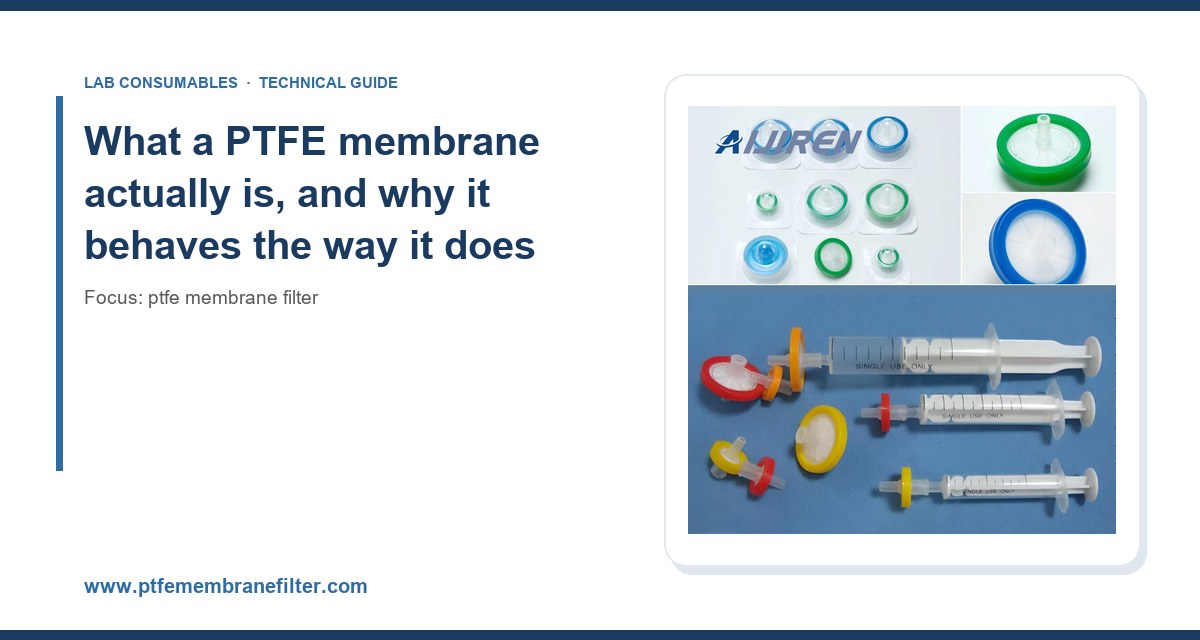
I still remember the first time a filtration step quietly ruined an entire batch of HPLC data. The membrane looked fine, the vacuum was steady, and yet every injection came back with a shoulder on the main peak and a ghost peak at 8.2 minutes. The culprit was a 0.45 µm PTFE disc that had been sitting in a drawer for two years and had picked up plasticizer contamination from its own packaging. That afternoon taught me a lesson I have repeated to every procurement manager I’ve worked with since: a PTFE membrane filter is not a commodity line item. It is a component with a specification, a failure mode, and a shelf life, and if you treat it like a paper towel you will pay for it in rework.
This guide is what I wish someone had handed me back then. It covers how PTFE membranes actually work, which numbers on a datasheet matter and which are marketing, how to match a filter to your specific workflow (aqueous, solvent, gas, venting, sample prep), what to check on receipt, and how to troubleshoot when filtration goes wrong. I’ll give you dimensions, temperature ratings, bubble point values, torque figures, and a decision checklist you can hand to a junior analyst.
Polytetrafluoroethylene is a fluoropolymer built from a carbon backbone fully shielded by fluorine atoms. That fluorine shell is what gives PTFE its near-universal chemical inertness. It does not swell in toluene, it does not hydrolyze in concentrated hydrochloric acid, and it does not leach the way cellulose acetate or nylon will. For a lab that runs everything from 0.1% formic acid in water to dichloromethane gradients on the same bench, that inertness is the whole reason PTFE exists as a filter material.
The trade-off is surface energy. PTFE has one of the lowest surface energies of any polymer, roughly 18 dyn/cm. Water beads on it. A raw PTFE membrane will not wet with water at any reasonable pressure, which is why almost every PTFE filter sold for aqueous or mixed-phase work is either hydrophobic (native) or hydrophilic (surface-modified). You need to know which one you have before you open the box, because using the wrong one is the single most common filtration mistake I see.
Hydrophobic versus hydrophilic PTFE
Hydrophobic PTFE is the native material. It passes organic solvents, gases, and vapors but repels water. This makes it the correct choice for gas venting, vacuum manifold protection, and solvent-based mobile phases. It is the wrong choice for filtering an aqueous buffer unless you pre-wet it with a small volume of alcohol first, and even then the wetting is fragile.
Hydrophilic PTFE has been surface-modified, usually by grafting a thin hydrophilic coating or by blending a perfluorinated comonomer into the surface layer. It wets with water and passes aqueous solutions without pre-wetting. The trade-off is a slightly reduced chemical resistance at the surface and a small increase in extractables. For aqueous sample prep and biological buffers, hydrophilic PTFE is usually the right call. For aggressive solvents, stick with hydrophobic.
Supported versus unsupported membranes
An unsupported PTFE membrane is a thin, fragile disc, typically 50 to 100 µm thick. It has excellent flow but tears easily and cannot be pleated into a cartridge without a backing. A supported membrane is laminated to a polypropylene or polyethylene backing, which adds mechanical strength, allows pleating, and raises the burst pressure. For syringe-tip filters and vacuum discs, supported is the norm. For inline cartridge filters in a pilot skid, supported is mandatory. If you are buying bare discs for a filtration rig you built yourself, check the burst rating: unsupported PTFE discs typically fail around 0.7 to 1.0 bar differential, supported versions handle 3 to 5 bar.
Pore size: the number that matters most, and the one most often misread
Pore size ratings on PTFE membranes are nominal, not absolute, and the difference matters. A “0.45 µm” membrane does not have a 0.45 µm hole; it has a distribution of pores with a mean around 0.45 µm and a tail that extends well above and below. The bubble point test is the only reliable way to verify what you actually have, and it is the number I ask for on every certificate of analysis.
Bubble point is the pressure at which air pushes through a wetted membrane. It is inversely related to pore size: smaller pores need higher pressure to break through. For a typical hydrophobic PTFE membrane, expect the following approximate values with isopropanol as the wetting fluid:
- 0.2 µm: bubble point roughly 1.5 to 2.0 bar (22 to 29 psi). Used for sterile filtration and particulate removal ahead of HPLC.
- 0.45 µm: bubble point roughly 0.7 to 1.0 bar (10 to 15 psi). The workhorse for general sample prep and mobile phase filtration.
- 1.0 µm: bubble point roughly 0.3 to 0.5 bar. Used for pre-filtration and viscous samples.
- 5.0 µm: bubble point roughly 0.1 bar. Used for coarse clarification and venting.
If a supplier cannot give you a bubble point specification, or gives you one that is wildly off these ranges, walk away. The certificate is your only defense against a mislabeled lot.
Choosing pore size by workflow
Here is how I map pore size to task, based on years of running these filters through everything from ICP-MS prep to pilot-scale clarification:
- HPLC and UHPLC mobile phase filtration: 0.45 µm for conventional columns (4.6 mm ID, 5 µm particles), 0.2 µm for UHPLC columns (2.1 mm ID, sub-2 µm particles). The rule is simple: filter to at least half the particle size of your column packing. A 1.8 µm column wants a 0.2 µm filter, no exceptions.
- Sample prep before injection: 0.2 µm for LC-MS and anything going onto a small-particle column. 0.45 µm is acceptable for older 5 µm methods but I have seen it cause injector frit plugging on modern systems.
- Gas venting and vacuum manifold protection: 0.2 µm hydrophobic. This blocks aerosol carryover without restricting flow.
- Solvent clarification and particulate removal: 0.45 µm is the default; drop to 1.0 µm for viscous samples like oils or polymer solutions where 0.45 µm would plug before you finish.
- Sterile filtration of liquids: 0.2 µm absolute-rated, and verify the bubble point on the lot.
Diameter and format: matching the filter to the holder
The physical format is where buyers get tripped up, because a 47 mm disc does not fit a 50 mm holder and a 13 mm syringe filter does not hold enough volume for a 10 mL sample. Here are the formats I keep on the shelf and what each is for:
- 13 mm syringe filters: hold 1 to 10 mL comfortably. Good for small sample volumes and expensive reagents. Dead volume is low, which matters when your sample is 500 µL.
- 25 mm syringe filters: hold 10 to 50 mL. The general-purpose size for most HPLC sample prep.
- 33 mm syringe filters: hold 50 to 100 mL. Use when you are filtering a batch of samples and do not want to change filters mid-run.
- 47 mm discs: the standard vacuum filtration size. Fits a standard 47 mm filter holder and a 250 mL to 1 L filtration flask. This is the size I specify for mobile phase preparation.
- 90 mm and 142 mm discs: for larger-volume clarification and pilot work. Check your holder’s nominal diameter; a 90 mm disc in an 85 mm holder will wrinkle and bypass.
For inline cartridge formats, the key numbers are the connection type and the effective filtration area. A typical 10-inch cartridge with 0.2 µm hydrophobic PTFE has an effective area around 0.6 to 0.7 m² and a flow rate of several liters per minute at modest differential pressure. Match the cartridge to the housing, and check the O-ring material: silicone is fine for aqueous, but for aggressive solvents use PTFE-encapsulated or fluoroelastomer seals.
The selection checklist: a decision table you can actually use
This is the table I hand to new analysts. It maps the workflow to the filter specification in one line. Print it, laminate it, tape it to the bench.
| Workflow | Wettability | Pore size | Format | Key spec to verify |
|---|---|---|---|---|
| HPLC mobile phase, aqueous/organic | Hydrophobic (or hydrophilic if aqueous only) | 0.45 µm | 47 mm disc | Bubble point ≥ 0.7 bar; extractables < 0.1% |
| UHPLC mobile phase | Hydrophobic | 0.2 µm | 47 mm disc | Bubble point ≥ 1.5 bar |
| LC-MS sample prep | Hydrophilic | 0.2 µm | 13 or 25 mm syringe | Low extractables; no surfactant leach |
| Gas venting / vacuum protection | Hydrophobic | 0.2 µm | Syringe or cartridge | Burst pressure ≥ 1 bar; airflow rate |
| Solvent clarification | Hydrophobic | 0.45 µm | 47 mm disc or cartridge | Chemical compatibility with solvent class |
| Viscous sample pre-filtration | Hydrophobic | 1.0 µm | 25 mm syringe | Hold-up volume; burst pressure |
| Sterile liquid filtration | Hydrophilic | 0.2 µm absolute | Cartridge | Bubble point per lot; integrity test |
If you only remember one row, remember the HPLC mobile phase row. A 0.45 µm hydrophobic PTFE disc in a 47 mm holder, verified by bubble point, will solve 80% of the filtration problems that walk into my lab.
Chemical compatibility: where PTFE wins and where it does not
PTFE is compatible with almost everything, but “almost” is doing work in that sentence. It is attacked by molten alkali metals, by fluorine gas at elevated temperature, and by some strong fluorinating agents. In a normal analytical lab you will never see those. What you will see is a compatibility problem with the housing, not the membrane. A PTFE membrane in a polypropylene syringe filter is only as resistant as the polypropylene, and polypropylene is attacked by things like concentrated nitric acid and some chlorinated solvents at elevated temperature.
For aggressive work, specify an all-PTFE or PTFE-lined housing. For standard HPLC solvents (acetonitrile, methanol, water, formic acid, trifluoroacetic acid, buffer salts), a polypropylene housing with a PTFE membrane is fine. For concentrated nitric or sulfuric acid, or for hot solvent above 60 °C, go all-PTFE and check the temperature rating.
Temperature ratings
PTFE itself is rated to 260 °C continuous. The assembly is the limit. A polypropylene-housed syringe filter typically tops out around 60 to 80 °C. An all-PTFE filter can go much higher, but the backing and seals may not. If you are filtering hot mobile phase or running a high-temperature application, ask for the assembly rating, not the membrane rating. I have seen a 90 °C filtration step soften a polypropylene housing enough to leak at the Luer connection, which is a mess and a safety issue.
Extractables, leachables, and the ghost peak problem
This is the failure mode that costs the most money and is the hardest to diagnose. Every membrane has extractables, and PTFE is better than most but not zero. Manufacturing residues, mold release agents, and packaging plasticizers can all leach into your filtrate. In HPLC, they show up as ghost peaks, baseline drift, or a shoulder on your analyte. In LC-MS, they show up as elevated background and suppressed ionization.
The defense is threefold. First, buy membranes with a stated extractables specification, ideally below 0.1% by weight after a defined rinse. Second, pre-rinse the filter with the same solvent you are about to filter, discarding the first few milliliters. Third, store membranes in their original packaging, sealed, away from solvent vapors and heat. A membrane that has been open on the bench for a month is a contamination source, not a filter.
If you are running trace analysis, the filter is part of your sample preparation chain, and it needs to be treated with the same rigor as your vial insert and your 2 mL vial. A clean insert in a contaminated vial is still a contaminated sample.
Receiving inspection: what to check before you trust a lot
I do not take a membrane lot on faith. Here is the incoming check I run on a new supplier or a new lot, and it takes about 20 minutes:
- Visual: inspect for pinholes, discolorations, creases, and delamination on supported membranes. Hold a disc up to a light source; a pinhole shows as a bright spot.
- Bubble point: wet a disc with isopropanol, mount it in a holder, and pressurize slowly. Record the pressure at first bubble. Compare to the certificate. A reading more than 15% below spec is a reject.
- Dimensions: measure the diameter with calipers. A 47 mm disc should be 47 ± 0.5 mm. If it is undersized, it will bypass in the holder.
- Weight: weigh a disc on an analytical balance. A significant deviation from the nominal weight suggests a thickness or density problem.
- Flow rate: time the filtration of a known volume of water or solvent through a disc at fixed vacuum. A slow lot means a partially plugged or denser membrane.
Keep a log. After a year you will have a supplier performance record that is worth more than any datasheet.
Operational precautions: the things that actually break filters
Most filtration failures I see are operator errors, not product defects. Here is my short list of rules I enforce on the bench:
Wetting and pre-wetting
Hydrophobic PTFE will not wet with water. If you must filter an aqueous sample through hydrophobic PTFE, pre-wet with a small volume of isopropanol or ethanol, then flush with water before use. Do not skip the flush, or you will inject alcohol into your sample. If you filter aqueous samples regularly, buy hydrophilic PTFE and stop fighting the material.
Pressure and vacuum limits
Never exceed the burst pressure of the housing. For a polypropylene syringe filter, that is typically 5 to 7 bar; for an unsupported disc in a vacuum setup, keep the differential below 0.7 bar. A collapsed membrane lets everything through, including the particles you were trying to remove. Use a vacuum regulator, not full house vacuum, on a 47 mm disc.
Torque and connections
On cartridge housings, follow the manufacturer’s torque spec. Over-torquing crushes the O-ring and causes bypass; under-torquing leaks. A typical 10-inch housing wants 15 to 25 N·m on the closure, but check your specific housing. For Luer connections on syringe filters, hand-tight is enough; a quarter turn past finger-tight is the maximum before you risk cracking the housing.
Puncture counts and syringe filter reuse
Syringe filters are single-use. The septum and housing are not designed for multiple punctures, and the membrane can be damaged by the needle. If you are piercing a septum to draw sample, use a fresh needle and a fresh filter. I have seen a filter reused three times and the third filtrate carried particles from the first sample. That is a data integrity problem, not a convenience.
Gas and venting applications: a different set of numbers
PTFE’s hydrophobic nature makes it the default vent membrane for gas and vapor. In a vacuum manifold, a 0.2 µm hydrophobic PTFE disc blocks aerosol and liquid carryover while passing air at high flow. The key specs here are airflow rate and water intrusion pressure. A good vent membrane holds back water to 0.5 to 1.0 bar and passes air at several liters per minute per square centimeter. If you are venting a solvent reservoir, check that the membrane is compatible with the solvent vapor, because some solvents will wet a hydrophobic membrane over time and cause it to drip.
For GC applications, the vent membrane protects the column and detector from particulate and moisture. If you are running a GC method, the sample path includes the vial, the septum, and the filter, and each one is a potential source of contamination. Consult the instrument vendor’s guidance, for example Agilent’s GC columns and accessories documentation, for the specific venting requirements of your system.
Method and regulatory context
If you work in an accredited lab, the filter is part of your method and must be documented. For environmental work, the U.S. EPA’s SW-846 test methods specify filtration steps for many sample preparation procedures, and the filter material and pore size are part of the method. Deviating from the specified filter without a documented equivalency study is a finding waiting to happen. For pharmaceutical work, USP general chapters on filtration and sterility require integrity testing, and the bubble point is the test of record.
Keep the certificate of analysis for every lot, and keep the bubble point record with it. When an auditor asks how you know the filter performed as specified, the answer is the certificate plus your incoming test log.
Troubleshooting checklist: when filtration goes wrong
Here is the checklist I run when a filtration step misbehaves. Work top to bottom; the most common causes are first.
- Slow flow or plugged filter: sample too viscous or particle load too high. Pre-filter with a larger pore size (1.0 µm then 0.45 µm), or use a larger diameter. Check that you are not exceeding the recommended sample volume for the filter size.
- Ghost peaks or baseline drift in HPLC: extractables from the membrane or the housing. Pre-rinse, switch to a lower-extractables membrane, and check storage conditions.
- Bypass around the membrane: wrong disc diameter for the holder, wrinkled disc, or damaged O-ring. Measure the disc and inspect the seal.
- Membrane rupture: exceeded burst pressure, or incompatible solvent attacked the housing. Check the pressure and the compatibility chart.
- Water will not pass: hydrophobic membrane used for an aqueous sample. Switch to hydrophilic PTFE or pre-wet with alcohol.
- Contamination in the filtrate: reused filter, contaminated packaging, or a pinhole. Inspect the disc against a light and use a fresh filter.
- Inconsistent results between lots: no incoming bubble point test. Start testing every lot and keep a supplier log.
Where to buy, and what to ask
For standard lab volumes, the major distributors carry PTFE membranes from several manufacturers, and the product lines from Thermo Fisher’s chromatography and sample handling range and Restek’s technical resources are good starting points for specifications and compatibility data. For specialty formats, custom diameters, and volume pricing, a dedicated membrane supplier is usually the better call. Our own PTFE membrane filter line covers the standard disc and syringe formats, and we publish bubble point and extractables data per lot.
When you talk to a supplier, ask four questions: What is the bubble point specification and is it tested per lot? What is the extractables specification and how is it measured? What is the assembly temperature rating, not just the membrane rating? And what is the shelf life and storage recommendation? A supplier who can answer all four in writing is a supplier you can build a method around. One who cannot is a risk you are taking on your own data.
One more note on the sample path. The filter does not exist in isolation. If you are filtering into a COD vial or a standard autosampler vial, the cleanliness of that vial matters as much as the membrane. I have traced a persistent low-level contaminant to a batch of vials, not the filter, and it took a week to find because we assumed the filter was the problem. Test the whole chain.
Takeaway
Choose a PTFE membrane by workflow, not by price. Match wettability to your sample (hydrophobic for solvents and gases, hydrophilic for aqueous), match pore size to your column or application (0.2 µm for UHPLC and LC-MS, 0.45 µm for conventional HPLC and general clarification), match format to your holder and volume, and verify every lot with a bubble point test. Keep the certificate, store the membranes sealed, pre-rinse before use, and never reuse a syringe filter. Do those things and the filter stops being a variable in your data. Skip them and you will spend an afternoon chasing a ghost peak that a 47 mm disc put there.
References & further reading
Related resources from our lab consumables network:
- Ptfe Membrane Filter at ptfemembranefilter.com
- Cod Vial at codvial.com
- Vial Insert at hplcinsert.com
- 2Ml Vial at 2mlsamplevial.com
External references and standards: