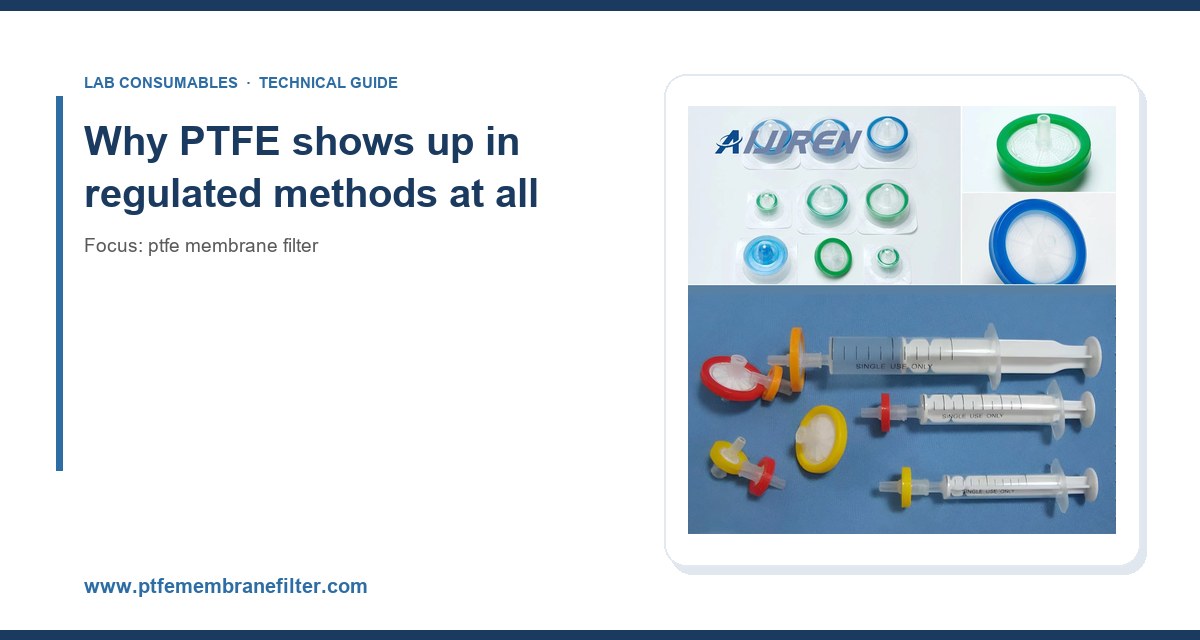
I lost three weeks of method validation time in 2019 because a 0.45 µm PTFE syringe filter leached a UV-active compound that co-eluted with my analyte at 254 nm. The method was an in-house modification of EPA 8270, the filter was “the same one we always use,” and the lot number had changed. That experience rewired how I think about membrane filters in regulated work: they are not passive plumbing. They are a sample preparation variable that can shift recovery, add peaks, or fail an audit if you cannot document what you used and why.
What follows is what I actually do now when a PTFE membrane filter has to live inside an EPA, ISO, or AOAC method. I will cover the material science that matters, the specific clauses and conventions in each method family, selection criteria with numbers, and the failure modes I have had to troubleshoot on the bench.
Polytetrafluoroethylene is a fully fluorinated polymer. The carbon backbone is wrapped in fluorine atoms, which is why it has essentially no extractable organic character, near-universal chemical resistance, and a service temperature range that runs from roughly -200 °C to +260 °C for virgin PTFE. For analytical filtration, the practical working range is narrower, but a PTFE membrane will survive autoclaving at 121 °C, tolerate contact with concentrated nitric acid and hydrochloric acid, and stay dimensionally stable in solvents that dissolve cellulose acetate, nylon, and even some PVDF grades.
That chemical inertness is the entire reason PTFE appears in methods that involve aggressive matrices: acid digests, solvent extracts, alkaline hydrolysis, and anything with a high organic load. A cellulose acetate membrane in a 1:1 dichloromethane extract will start to swell and shed fibers within minutes. A nylon membrane will adsorb proteins and some polar analytes. PTFE does neither, at least not to a degree that shows up in recovery data.
The two PTFE product forms you will actually buy
There are two distinct products sold as “PTFE membrane filters,” and confusing them is a common source of method failure.
- Hydrophobic PTFE is the default. It repels water, which makes it ideal for venting, gas filtration, and filtration of non-aqueous solvents. It will not wet out with aqueous solutions unless you pre-wet it with a small volume of methanol or isopropanol.
- Hydrophilic PTFE is chemically modified (typically by grafting or coating) to wet with water. It is what you want for aqueous sample filtration in HPLC and IC methods, but the modification introduces a small amount of extractable material. In trace organic work, that matters.
For most regulated organic methods (EPA 8270, 625, 608), you want hydrophobic PTFE and you pre-wet. For aqueous IC and dissolved metals work, hydrophilic PTFE or a different membrane chemistry entirely is usually the better call. If you need a general-purpose reference on the material, our own PTFE membrane filter page covers the pore size and format options in detail.
What EPA SW-846 actually says about filtration
SW-846 is performance-based. That is the phrase you need to internalize. The methods describe the analytical result you must achieve and the quality control you must demonstrate, not the exact brand of filter you must use. EPA SW-846 explicitly allows modification of the sample preparation as long as you document it and demonstrate equivalent performance through the method’s QC criteria (initial demonstration of capability, ongoing precision and recovery, matrix spikes).
In practice, this means the filter is a documented method variable. My rule is simple: if a filter touches the sample, it goes in the method narrative with manufacturer, part number, pore size, diameter, and membrane material. Auditors ask for this more often than people expect.
Specific method touchpoints
A few SW-846 methods have filtration language worth knowing:
- Method 3005A and 3010A (acid digestion of waters and solids) specify filtration through a 0.45 µm membrane for dissolved metals. PTFE is acceptable and common when the digest is hot or strongly acidic.
- Method 3510C and 3520C (liquid-liquid and continuous liquid-liquid extraction) do not mandate a filter, but many labs filter the aqueous phase before extraction to remove particulates that cause emulsions. PTFE is the safe choice here because it will not add organic artifacts to the extract.
- Method 8270E (semivolatiles by GC-MS) has no filter clause, but the extract cleanup steps are where filter artifacts show up as false positives. A PTFE filter that leaches a phthalate or a plasticizer will produce a hit in the library search.
That last point is worth dwelling on. I have seen a di-n-butyl phthalate false positive traced to a filter housing gasket, not the membrane itself. The membrane was fine; the polypropylene housing was the source. If you are running phthalate methods, buy filters with the smallest possible housing mass and run a filter blank.
ISO methods: tighter language, tighter tolerances
ISO methods are less forgiving than SW-846. Where SW-846 says “performance-based,” ISO typically says “shall” and specifies the pore size, the membrane material class, and sometimes the filtration apparatus. That is good for reproducibility and bad for anyone who wants to substitute a cheaper filter.
ISO 5667 and water sampling
ISO 5667 (water quality, sampling) establishes the general framework, and its parts on sample preservation and handling specify filtration for dissolved fractions. The convention is 0.45 µm for dissolved metals and major ions, and 0.22 µm when the target is truly dissolved or when biological stability matters. PTFE is acceptable for the dissolved metals fraction because it does not adsorb cations appreciably and it tolerates the nitric acid preservation.
ISO 9377 and oil-in-water
ISO 9377-2 (determination of hydrocarbon oil index) uses solvent extraction followed by GC-FID. Filtration is not the centerpiece, but sample handling before extraction matters. PTFE is the membrane of choice because it will not adsorb the C10 to C40 hydrocarbons you are trying to quantify. I have seen nylon membranes pull 5 to 10 percent of the heavier fraction out of a sample, which is enough to fail a proficiency test.
ISO 17025 and the documentation angle
ISO/IEC 17025 is the accreditation standard, not an analytical method, but it is the reason filter documentation matters. Clause 6.4 (equipment) and clause 7.2 (methods) require you to identify anything that can influence the result and control it. A filter that touches the sample is equipment. It needs an ID, a calibration or verification record where applicable, and a place in your method.
My practical implementation: every filter lot gets a receiving inspection record with pore size verification (bubble point or a simple dye test), and every method gets a filter blank run at method detection limit. That blank is the single most useful piece of QC I have added in the last decade.
AOAC methods: the food and supplement angle
AOAC International methods are where I see the most filter-related variability, because food matrices are messy and the sample prep is often where the method is weakest. AOAC methods are validated through a multi-laboratory study, which means the filter used in the study becomes, de facto, part of the method. Substituting a different filter without re-validating is a common audit finding.
Where PTFE fits in AOAC work
PTFE is common in AOAC methods for:
- Fat and oil analysis, where the membrane must tolerate hexane, petroleum ether, and hot solvent without swelling.
- Vitamin and supplement assays, particularly fat-soluble vitamins extracted in organic solvent.
- Pesticide residue methods (the QuEChERS family, AOAC 2007.01), where filtration is used to remove co-extractives before LC-MS/MS. PTFE is not always the right choice here; some QuEChERS protocols specify a PTFE filter with a 0.2 µm pore size and a polypropylene housing, and the housing is where the extractables come from.
For QuEChERS specifically, I recommend running a matrix-matched calibration and a filter blank for every new lot. The filter is a small cost line and a large source of false positives in a method that is already fighting co-extractive interference.
Selection criteria with numbers
Here is the decision framework I use. These are the parameters that actually change results, with the numbers I have settled on after years of method development.
Pore size
- 0.45 µm is the default for dissolved-fraction work (metals, ions, general aqueous samples). It removes particulates that would clog a column or scatter light, and it is the size the regulatory language assumes.
- 0.22 µm is for sterility, for true-dissolved work, and for LC-MS/MS methods where sub-micron particles cause spray instability. Expect higher back pressure and slower filtration.
- 0.2 µm appears in some QuEChERS and pharmaceutical protocols. It is functionally close to 0.22 µm but not identical; do not substitute one for the other in a validated method without re-checking recovery.
- 1.0 µm and larger are for prefiltration and for heavily particulate samples. Use them ahead of a 0.45 µm filter to protect it, not as the final filter.
Diameter and hold-up volume
For a 13 mm syringe filter, hold-up volume is typically 10 to 25 µL. For 25 mm, it is 50 to 100 µL. For 33 mm, it is 100 to 150 µL. If your sample volume is under 1 mL, use 13 mm or you will lose a meaningful fraction of your analyte to the filter. This is where the choice of downstream vial matters: a 2 mL vial with a proper insert lets you work with small volumes without losing the sample to dead volume. If you are running small-volume injections, a vial insert is the right complement to a 13 mm filter.
Housing material
The membrane gets the credit, but the housing causes most problems. Polypropylene is the standard and is acceptable for most work. Acrylic housings are cheaper but leach more and are not solvent-compatible. For trace organic work, I look for housings with the smallest wetted surface area and I run a blank on every lot.
Temperature rating
Virgin PTFE membrane is rated to 260 °C. The housing is the limiting factor: most polypropylene housings are rated to 100 °C or lower. If your method involves hot filtration, you need a housing rated for it, or you need to cool the sample first. I have seen housings deform at 80 °C in a hot water bath, which caused bypass and invalidated the filtration.
Puncture and burst pressure
For syringe filters, the practical burst pressure is 5 to 7 bar (roughly 70 to 100 psi) for a 25 mm device. Exceeding it causes the membrane to rupture or the housing to leak. If you are pushing a viscous extract through a 0.22 µm filter, use a larger diameter or a prefilter rather than a bigger syringe.
Comparison table: PTFE versus the alternatives
Here is the table I keep taped inside my method binder. Numbers are typical values, not specifications from any one vendor.
- PTFE (hydrophobic): pore sizes 0.2 to 5 µm; temperature to 260 °C (membrane); excellent solvent resistance; low extractables; requires pre-wetting for aqueous samples. Best for organic extracts, aggressive acids, and trace organic work.
- PTFE (hydrophilic): same backbone, wets with water; slightly higher extractables than hydrophobic; temperature to 130 °C typical. Best for aqueous HPLC and IC samples.
- PVDF: pore sizes 0.22 to 0.45 µm; temperature to 100 °C; good solvent resistance but lower than PTFE; adsorbs some proteins. Good general-purpose choice, not the best for trace organics.
- Nylon: pore sizes 0.2 to 0.45 µm; temperature to 100 °C; adsorbs proteins and some polar analytes; not solvent-compatible with chlorinated solvents. Avoid for organic extracts.
- Cellulose acetate: pore sizes 0.2 to 0.45 µm; temperature to 120 °C; poor solvent resistance; swells in many organics. Use for aqueous and biological samples only.
- Glass fiber: pore sizes 0.7 to 2.7 µm; temperature to 500 °C; high particulate capacity; not a sterilizing filter. Use as a prefilter.
If you want vendor-side data on membrane compatibility, Thermo Fisher’s chromatography and sample handling resources and Restek’s technical library both publish solvent compatibility tables that are more current than most textbooks. For column and consumable cross-references, Agilent’s GC columns and accessories pages are useful when you are matching a filter choice to a specific column chemistry.
Operational precautions that actually matter
These are the things I wish someone had told me in year one.
Pre-wetting is not optional
Hydrophobic PTFE will not pass water. You pre-wet with 1 to 2 mL of methanol or isopropanol, then flush with the aqueous sample. Skip this and you will either get no flow or you will force the sample around the membrane, which is worse than no filtration at all. I have watched analysts push a syringe until the housing cracked rather than admit the membrane was dry.
Discard the first fraction
The first 1 to 2 mL through a syringe filter carries the highest extractable load. Discard it. For a 13 mm filter, discard the first 0.5 mL. This single practice has removed more spurious peaks from my chromatograms than any other change.
Do not reuse
Syringe filters are single-use. Reusing one across samples is a cross-contamination event waiting to be documented in an audit. The cost per filter is a few dollars; the cost of a re-run is a day.
Match the syringe to the filter
A 1 mL syringe with a 25 mm filter is a mechanical mismatch; you cannot generate the pressure to push a viscous sample through. Use a 3 to 5 mL syringe with 25 mm, and a 1 mL syringe with 13 mm. This sounds obvious until you watch someone fight a 0.22 µm filter with a 1 mL syringe for ten minutes.
Watch the housing, not just the membrane
Most extractable-related failures I have investigated were housing failures, not membrane failures. Polypropylene housings can leach antioxidants and plasticizers. If you are running trace organics, buy the housing with the smallest mass and the fewest additives, and verify with a blank.
Troubleshooting checklist
When a filtration step goes wrong, work through this list in order. It is the checklist I use on the bench, and it has never failed to find the cause.
- No flow or very slow flow: membrane is dry (pre-wet), pore size too small for the matrix (go from 0.22 to 0.45 µm), sample is too viscous (dilute or warm), or particulate load is too high (add a glass fiber prefilter).
- False positives in the chromatogram: run a filter blank with the same lot. If the peak appears, it is the filter. Check housing extractables first, then membrane.
- Low recovery: check hold-up volume against sample volume (13 mm for under 1 mL), check for analyte adsorption to the housing, and confirm the discard volume is correct.
- Housing deformation or leakage: pressure exceeded the burst rating (5 to 7 bar for 25 mm), or temperature exceeded the housing rating (100 °C for most polypropylene).
- Inconsistent results across analysts: pre-wetting technique differs, discard volume differs, or syringe size differs. Standardize all three in the SOP.
- Audit finding on filter documentation: lot number, part number, pore size, and membrane material are not in the method narrative. Add them.
What I recommend
For regulated analytical work, here is the configuration I would put in a new method today:
- Hydrophobic PTFE, 0.45 µm, 25 mm for organic extracts and aggressive matrices, with a 1.0 µm glass fiber prefilter for particulate-heavy samples.
- Hydrophilic PTFE, 0.22 µm, 13 mm for aqueous samples going to LC-MS/MS, with the first 0.5 mL discarded.
- Polypropylene housing with the smallest wetted mass available, and a filter blank run on every lot.
- Documentation in the method narrative: manufacturer, part number, pore size, diameter, membrane material, housing material, and lot number.
Pair the filter choice with the right downstream consumable. A COD vial for the digestion step, a 2 mL vial with an insert for the final extract, and a consistent filter lot across the whole batch. The filter is a small line item in the method; the cost of getting it wrong is a failed validation and a re-run.
The takeaway is straightforward. PTFE membrane filters are not interchangeable commodities in regulated methods. The membrane chemistry is the easy part; the housing, the pore size, the discard volume, and the documentation are where methods pass or fail. Pick the configuration deliberately, run the blank, and write it down. That is the whole discipline.
References & further reading
Related resources from our lab consumables network:
- Ptfe Membrane Filter at ptfemembranefilter.com
- Cod Vial at codvial.com
- Vial Insert at hplcinsert.com
- 2Ml Vial at 2mlsamplevial.com
External references and standards: