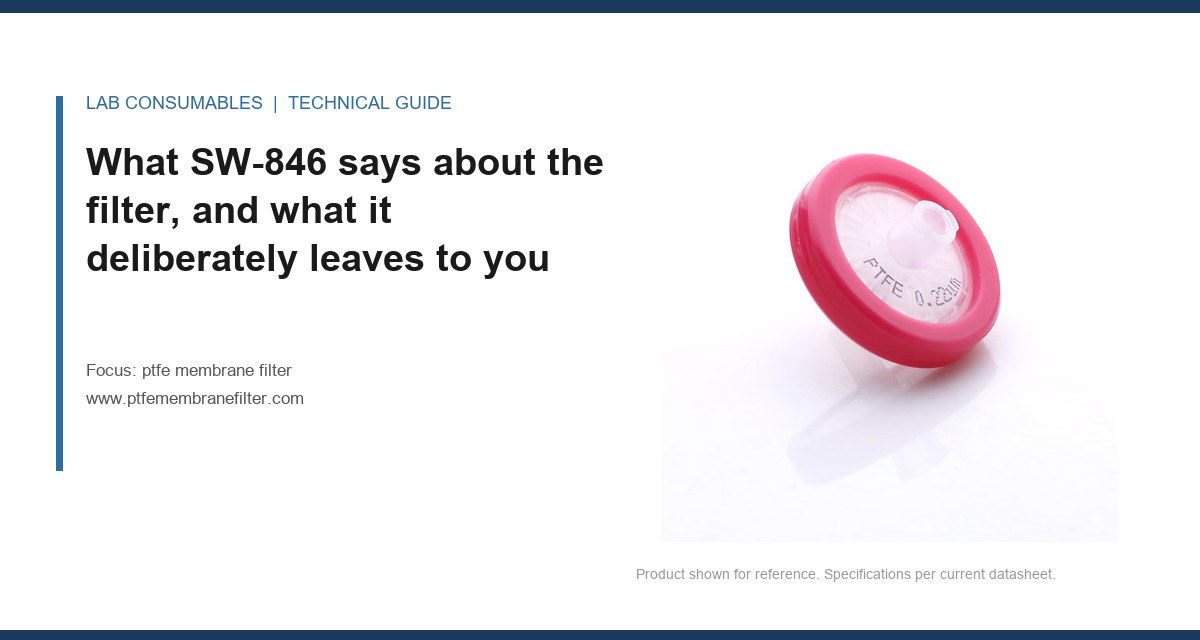
A 500 mL amber glass bottle arrived at the bench with 380 mL of aqueous sample, a PTFE-lined screw cap torqued to maybe 1 ft-lb by hand, and a chain-of-custody form that listed the collection time as 14:20 when the field log said 14:05. The lab ran the metals by SW-846 3010A/6010D and the VOCs by 8260C. The metals data were fine. The VOC run came back with toluene at 11 µg/L in the method blank and the whole batch was flagged. The auditor who reviewed that project six months later did not start with the chromatograms. She started with the bottle, the cap liner, and the fifteen minutes of disagreement on the COC. That is the reality of EPA method requirements for a PTFE membrane filter and the auditor expectations that come with them: the membrane is rarely the headline, but it is almost always in the paper trail somewhere, and the paper trail is what gets examined first.
This piece is about what SW-846 and the method-specific container and handling language actually demand of a PTFE membrane filter, and what an auditor pulls out of the binder before she looks at a single peak. It is not a primer on what PTFE is or why it is used. It assumes you already run it and now have to defend it.
SW-846 is a guidance compendium, not a regulation. That distinction matters more for filters than for almost any other consumable. The methods describe the performance the sample preparation must achieve and leave the hardware choice to the analyst. Chapter One and Chapter Three of SW-846 set the tone: the laboratory is responsible for demonstrating that its containers, filtration, and handling do not introduce bias or lose analytes. The method number tells you the analyte list and the QC; the container and filtration detail is often one sentence in the method and a paragraph in Chapter Three.
Take 3005A, the hot-block or hot-plate acid digestion for metals. It does not name a membrane material. It tells you to filter the digestate to remove particulates before analysis, and it warns that the filter must not adsorb or leach the metals of interest. For a PTFE membrane with a 0.45 µm rating, that is a green light, but the green light is conditional on you having a documented blank. The method blank, prepared through the same filtration step with the same lot of membrane, is the evidence. If your blank shows zinc at 3 µg/L and your reporting limit is 5 µg/L, you have a problem that no certificate of analysis will fix.
For 8260C and the volatile methods, the language shifts to the container. The method specifies that aqueous samples for VOCs be collected in glass with a PTFE-faced silicone septum or a PTFE-lined cap, filled with zero headspace, and that the septum face in contact with the sample be PTFE. That is the one place where the membrane and the container are the same conversation. A COD vial or a 40 mL VOC vial with a PTFE-lined septum is doing the same job as a filtration membrane: it is a PTFE barrier between the sample and everything else. If the liner is the wrong grade, or the cap is torqued so the liner extrudes, you get a leak path and a lost analyte.
What SW-846 does not do is tell you the pore size, the diameter, the membrane thickness, or the lot acceptance test. Those are yours to define and defend. The auditor’s job is to see whether you defined them and whether your records show you held to your own definition. That is the whole game.
The container and handling language auditors actually quote back at you
When an auditor opens the binder, the first pages are not the instrument printouts. They are the sample receipt log, the COC, and the container specification. The method-specific container requirements are the ones that get quoted verbatim in a finding, so know them cold:
- 8260C: glass container, PTFE-lined septum or PTFE-faced silicone septum, zero headspace, no headspace bubble larger than a pea. Preserved to pH <2 with HCl, chilled to 4 °C ± 2 °C.
- 8270E: amber glass, PTFE-lined cap, 1 L preferred, 4 °C ± 2 °C, extracted within 14 days (7 days to extraction for some matrices).
- 3010A / 3005A: filtration after digestion, membrane must not adsorb or contribute the target metals. Document the membrane lot and the method blank.
- 3510 / 3511 (separatory funnel and continuous liquid-liquid): the extraction solvent contacts the filter only if you filter the extract; the membrane must be solvent-compatible. PTFE handles dichloromethane and hexane; cellulose does not survive the former well.
The handling language is where most findings live. SW-846 Chapter Three asks for a documented chain of custody, a receipt inspection, and a record of any deviation from the method. The auditor will ask three questions in the first ten minutes: who received the sample, when, and did the container meet the method’s specification at receipt. If the answer to the third is “we did not check,” the finding writes itself. A 2mL vial used as a secondary container for a small-volume aqueous sample has to meet the same PTFE-septum requirement as the primary bottle if the method names a septum, and auditors know that.
The paperwork an auditor asks for before she looks at the data
I have sat through enough of these to know the order. The auditor asks for the sample receipt and login records first, then the COC, then the container and consumable lot documentation, then the QC summary, then the raw data. The filter paperwork sits in the third slot. What she wants to see, specifically:
Consumable lot traceability
A lot number on the box that ties to a certificate of analysis, and a record of which lot was used on which batch. If your bench sheet says “PTFE filter, 0.45 µm” and nothing else, you cannot answer the question “which lot was in the filtration step for the batch that failed.” The fix is a one-line field on the bench sheet: lot number and membrane part number. Two seconds per batch. It has saved more projects than any instrument maintenance log I have seen.
Membrane blank and method blank results
The method blank is the evidence the membrane did not contribute. The auditor wants to see blanks run at the frequency the method states (one per batch of 20 or fewer samples for most SW-846 methods) and wants the blank associated with the same membrane lot. A blank run with a different lot proves nothing about the batch in question. Keep the blanks and the lot numbers in the same row of the QC table.
Filtration record: what was filtered, when, and through what
Which sample, which membrane, which pore size, which diameter, and the time. This is the record that catches the classic error: a 47 mm membrane used in a 25 mm filter holder, or a membrane that was not pre-rinsed. The auditor is looking for consistency between the written procedure and the bench sheet. If the SOP says pre-rinse with 5 mL of reagent water and the bench sheet has no pre-rinse field, that is a finding even if every sample passed.
Deviation log
Every filter that tore, every holder that leaked, every sample that had to be re-filtered. The auditor does not penalize a documented deviation. She penalizes an undocumented one. A torn membrane that was replaced and the sample re-filtered with a note is fine. A torn membrane that was quietly replaced is a data integrity question.
Where the membrane grade and the method collide: three failure modes
The membrane itself is where method compliance gets physical. Three failure modes account for most of the filter-related findings I have seen.
Extractable contribution at low reporting limits
PTFE is chemically inert, but it is not extractable-free. Residual processing aids and the backing or support (if you use a supported membrane) can contribute at the low end. For 8270E with reporting limits in the low ng/L for some analytes, a membrane that has not been pre-cleaned can show up in the blank. The measurement that identifies it: run a membrane blank at the same volume and concentration factor as your samples and compare to the method blank. If the membrane blank is elevated and the method blank is not, the membrane lot is the source. The fix is a lot acceptance test (a membrane blank per lot) and a pre-rinse procedure written into the SOP.
Pore size drift and the 0.45 µm claim
The 0.45 µm rating is a bubble-point-derived number, and a lot that drifts toward 0.5 µm will pass particles your method assumed were removed. For metals by 3010A, that means the “dissolved” fraction is not dissolved. The measurement: a bubble point check on the lot, or a particle count on the filtrate. The fix is a lot acceptance specification with a bubble point range, not just a nominal pore size on the box. Ask your supplier for the bubble point distribution, not the mean.
Holder and diameter mismatch
A 47 mm membrane in a holder designed for 50 mm, or a membrane that is not seated flat, gives you a leak path around the edge. The result is a filtrate that is partly unfiltered. The measurement: a dye test or a pressure hold test on the assembled holder before the batch. The fix is a holder that matches the membrane diameter and a torque value on the holder cap. For most 47 mm holders, hand-tight plus a quarter turn is the working range; over-torque cracks the housing and under-torque leaks. Put the torque value in the SOP.
Decision checklist: is this PTFE membrane compliant for this method?
Before a new lot or a new method goes on the bench, run this checklist. It is the same list the auditor uses, in the same order.
| Check | What to verify | Concrete target |
|---|---|---|
| Method container requirement | Glass, PTFE-lined septum, zero headspace for VOCs | 8260C: no bubble > pea; pH <2; 4 °C ± 2 °C |
| Membrane material | PTFE, unsupported or supported as the method allows | Solvent compatibility for 3510/3511 solvents |
| Pore size | Bubble point, not nominal | 0.45 µm nominal, bubble point within lot spec |
| Diameter vs holder | Membrane seated flat, no edge leak | 47 mm in 47 mm holder; holder torque documented |
| Lot traceability | Lot number on bench sheet and QC table | One lot per batch, blank from same lot |
| Membrane blank | Run at sample volume and concentration factor | Below reporting limit for all target analytes |
| Pre-rinse | Written in SOP, recorded on bench sheet | 5 mL reagent water or method solvent, discard |
| Deviation log | Tears, leaks, re-filters documented | Every event, with time and lot |
Any “no” on this table is a finding waiting to happen. The table is also the fastest way to onboard a new analyst: hand them the table and a lot of membrane and let them work through it.
Two field cases where the paperwork and the membrane disagreed
Case 1: the toluene in the method blank
A lab running 8260C saw toluene at 8 to 12 µg/L in the method blank for three consecutive batches. The instrument was clean, the purge-and-trap trap was new, and the reagent water was fresh. The membrane was the suspect but the lot had a clean certificate. The measurement that identified it: the lab ran a membrane blank through the same filtration step with the same lot and got toluene at 9 µg/L, while a blank with no filtration was clean. The source was the storage: the membrane box had been left open on the bench next to an open solvent tray for two weeks. PTFE adsorbs volatile organics from the air. The fix was sealed storage, a lot acceptance blank on receipt, and a note in the SOP that membranes are stored in a sealed container away from solvent vapors. The audit finding was not for the toluene; it was for the missing storage record. That is the lesson.
Case 2: the zinc that was not in the sample
A metals lab running 3010A/6010D saw zinc at 4 to 6 µg/L in the method blank across two batches. The digestion vessels were acid-cleaned, the acid was trace-metal grade, and the water was 18.2 MΩ·cm. The membrane lot was new. The measurement: the lab ran a membrane blank at the same volume and found zinc at 5 µg/L, and a bubble point check on the lot showed a distribution wider than the previous lot. The supplier confirmed a change in the rinse water at the plant. The fix was a lot acceptance test for zinc on every incoming lot and a switch to a supplier who publishes the rinse water specification. The auditor’s question was simple: “Where is the lot acceptance record?” There wasn’t one. Now there is. The PTFE membrane filter was fine; the acceptance process was not.
The audit-prep routine that actually holds up
What I recommend, and what I have seen survive real audits, is a filter compliance file that lives next to the instrument log and gets updated per batch, not per year. It contains: the method-specific container and filtration requirement (quoted), the SOP section that implements it, the lot acceptance records, the membrane blanks tied to lot numbers, and the deviation log. When the auditor asks for the filter paperwork, you hand her one folder and she is done in ten minutes. That is the difference between a two-hour finding and a five-minute check.
The instrument side of the file matters too. If you are running GC or LC, the consumables documentation from your column and sample-handling supplier should be in the same file. Agilent’s GC columns and accessories documentation and Thermo Fisher’s chromatography and sample handling resources are the kind of vendor documentation an auditor will accept as supporting evidence for the instrument and consumable side. Restek’s technical resources are useful for the method-development and troubleshooting side. None of these replace your own lot records, but they support them.
One more thing on the sample container side: if you are using small-volume vials for re-analysis or for a vial insert to reduce volume, the insert and the septum have to meet the same PTFE requirement as the primary container if the method names a septum. Auditors check the secondary container too. A 2 mL vial with a non-PTFE septum used for a 8260C re-analysis is a finding, even if the primary bottle was perfect.
What to do when the method is silent on the membrane
Many SW-846 methods are silent on the membrane material. That silence is not permission to use anything. It is an obligation to document your choice and prove it does not bias the result. The proof is the membrane blank and the lot acceptance record. The documentation is the SOP and the bench sheet. The U.S. EPA SW-846 test methods page is the reference for the method text and the Chapter Three container and handling guidance; cite it in your SOP so the auditor sees you read it.
If you cannot produce a membrane blank for a lot, you cannot defend the lot. If you cannot produce a lot number for a batch, you cannot defend the batch. If you cannot produce a deviation log, you cannot defend the re-filter. Those three records are the entire compliance story for a PTFE membrane filter, and they are the first three things an auditor asks for.
The decision rule is simple: no membrane lot goes on the bench without a lot acceptance blank and a bench-sheet lot number, and no batch closes without a membrane blank tied to that lot. If you cannot meet both, the batch does not close. That is the standard an auditor will hold you to, and it is the standard you should hold yourself to before she arrives.
References & further reading
Related resources from our lab consumables network:
- Ptfe Membrane Filter at ptfemembranefilter.com
- Cod Vial at codvial.com
- Vial Insert at hplcinsert.com
- 2Ml Vial at 2mlsamplevial.com
External references and standards: