I have watched a postdoc ruin a 96-well plate of samples with a $40 box of filters. The membranes were the wrong polymer, the pore size was too small, and the syringe was pushed too hard. The samples came back with PTFE fibers and a shifted baseline. That single mistake cost three days of instrument time and a re-run. Most filter selection problems I see in labs are not exotic. They come from buying on price or habit instead of matching the membrane to the chemistry, the particle load, and the detection limit. This guide is the checklist I wish someone had handed me when I started running a QC bench.
Polytetrafluoroethylene is a fluoropolymer built from a carbon backbone fully shielded by fluorine atoms. That shell is what gives PTFE its near-universal chemical inertness. It resists strong acids, bases, oxidizers, and nearly every organic solvent you will put through an HPLC or GC autosampler. It also has one of the lowest surface energies of any solid, which means very little sticks to it. For sample preparation, that combination is hard to beat.
Two grades dominate lab filtration. The first is hydrophobic PTFE, the native form. Water beads on it and will not pass unless you apply pressure above its water breakthrough point, which for a 0.45 µm membrane is typically 0.7 to 1.4 bar (10 to 20 psi) depending on pore size and backing. The second is hydrophilic PTFE, made by grafting a hydroxyl or similar group onto the surface. It wets with aqueous solutions and passes water at low pressure while keeping most of the chemical resistance.
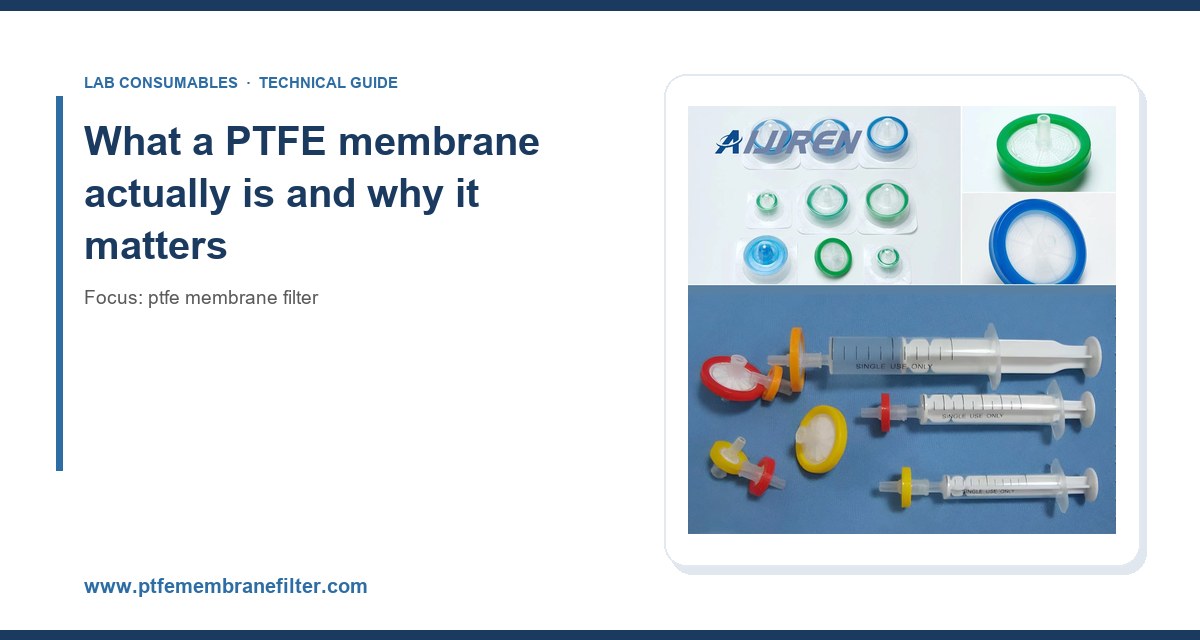
You will also see supported versus unsupported membranes. Supported PTFE has a polypropylene or polyethylene backing that gives it mechanical strength for vacuum and pressure filtration. Unsupported PTFE is thinner, has higher flow, and is common in syringe filters where the housing provides the support. The backing material matters because it is the part that can leach or fail under aggressive solvents. Ask for the backing spec, not just the membrane spec.
The selection criteria that actually decide the purchase
Pore size: match it to the particle you must remove, not to a habit
Pore size is the first number on the box and the one most often chosen by reflex. The standard lab sizes are 0.22 µm, 0.45 µm, and 1.0 µm, with 5 µm and larger available for prefiltration. The rule I use is simple: the membrane pore should be no larger than one-third the diameter of the smallest particle you must retain. For sterile filtration and mycoplasma removal, 0.22 µm is the working standard. For general HPLC sample cleanup, 0.45 µm removes the bulk of particulates that clog columns and injector lines.
Here is the trade-off people miss. Going from 0.45 µm to 0.22 µm roughly halves the flow rate at the same pressure and doubles the backpressure. On a 25 mm syringe filter, that can mean the difference between a 5-second push and a 30-second push that forces you to exceed the membrane’s burst rating. If your sample is particle-heavy, use a glass fiber prefilter ahead of the PTFE membrane rather than forcing everything through a tight pore.
Diameter and hold-up volume
Filter diameter controls two things: throughput and dead volume. A 13 mm syringe filter holds up to about 10 to 25 µL of liquid in the housing and membrane. A 25 mm unit holds roughly 50 to 100 µL. A 33 mm unit can hold 150 µL or more. If you are filtering 200 µL of a precious extract, a 13 mm filter with low hold-up is the right call. If you are filtering 50 mL of mobile phase, use a 47 mm or 50 mm vacuum filter and stop worrying about dead volume.
Low-binding housings matter here. Standard polypropylene housings adsorb some analytes, particularly hydrophobic compounds at low concentration. If you are working near the detection limit, specify a filter with a low-extractable, low-binding housing and pre-rinse it with 1 to 2 mL of the same solvent before collecting the filtrate.
Chemical compatibility: read the compatibility chart, then test
PTFE handles almost everything, but the housing and backing do not. Polypropylene housings are attacked by strong oxidizers, some chlorinated solvents at elevated temperature, and certain amines. The membrane may survive where the housing swells or cracks. I have seen a filter housing soften in dichloromethane within minutes, which is a housing failure, not a membrane failure.
Temperature ratings are the second compatibility axis. Native PTFE is rated for continuous service up to about 260 °C, but the polypropylene housing is typically limited to 80 to 100 °C, and the backing to a similar range. If you are filtering hot solutions, check the housing rating, not the polymer’s melting point. For autoclaving, most PTFE syringe filters tolerate 121 °C at 15 psi for 15 to 20 minutes, but verify the housing spec before you cycle them.
Extractables and leachables
Every filter sheds something. The question is whether the shed material lands in your chromatogram. PTFE itself is low-extractable, but manufacturing residues, mold release agents, and housing plasticizers can appear as ghost peaks. For trace analysis, request the extractables data: typically a gravimetric extractables value in mg per filter, and a UV or LC-MS profile after a defined rinse. A filter with under 0.5 mg extractables per 25 mm unit is a reasonable target for general work. For LC-MS at low ng/mL, you want the manufacturer’s solvent-specific extractable data, not a generic number.
Burst pressure and flow rate
Syringe filters are rated for a maximum inlet pressure, usually 5 to 7 bar (70 to 100 psi) for a 25 mm unit. Exceed it and the membrane can rupture or the housing can separate. The failure mode is quiet: you get a filter that passes particles it should have retained, and you never see it until the column pressure climbs. Use a syringe no larger than needed, push slowly, and never use a 50 mL syringe on a 13 mm filter. The mechanical advantage will blow the membrane.
A concrete comparison: choosing by workflow
The table below is the decision matrix I keep taped inside a lab cabinet. The numbers are typical values for commercially available units; confirm against the specific manufacturer’s datasheet before you buy.
- HPLC aqueous mobile phase, 0.45 µm: 47 mm supported hydrophilic PTFE, vacuum filtration, flow around 100 to 200 mL/min at 0.5 bar. Housing: polysulfone or PP. Replace when flow drops below 70% of initial.
- HPLC organic mobile phase, 0.45 µm: 47 mm hydrophobic PTFE, vacuum or pressure, flow 80 to 150 mL/min. Pre-wet with methanol or acetonitrile if using a hydrophilic unit; hydrophobic units need no pre-wet for organic solvents.
- Syringe filtration of 1 to 5 mL sample, 0.22 µm: 13 mm or 25 mm hydrophobic PTFE, low-binding PP housing, hold-up 10 to 50 µL, burst 5 to 7 bar. Pre-rinse with 1 mL solvent.
- Sterile filtration of media or buffer, 0.22 µm: 25 mm or 33 mm hydrophilic PTFE, autoclave-safe housing, rated to 121 °C. Verify sterility by membrane filtration per USP <71> if required.
- Trace LC-MS sample cleanup, 0.2 µm: 13 mm low-extractable PTFE, pre-rinsed, extractables under 0.5 mg per unit, housing certified for LC-MS.
- Particulate-heavy environmental sample, 1.0 µm: 25 mm or 47 mm PTFE with glass fiber prefilter, flow 50 to 100 mL/min, replace prefilter when differential pressure rises 0.3 bar.
Matching the filter to the sample container and the instrument
A filter does not work alone. The sample path runs from collection vessel to autosampler vial to column, and every junction is a chance to lose analyte or introduce particles. If you are filtering into a 2 mL vial, use a filter whose outlet fits the vial neck without a transfer step. That eliminates one open-container exposure and one chance for dust to land in the filtrate.
For small-volume work, filter directly into a vial insert. A 150 µL insert with a 13 mm syringe filter lets you filter and inject from the same container. If you are running COD or similar wet-chemistry tests, the filtrate often goes into a COD vial, and the filter must not contribute organic carbon. That is a case where you want a pre-rinsed, low-TOC PTFE unit and a blank filtration to prove it.
The instrument side matters too. Columns from Agilent and Thermo Fisher have inlet frits and guard columns that will catch what your filter misses, but they are not a substitute for filtration. A 0.2 µm or 0.22 µm filter upstream of a UHPLC column is cheap insurance against a $600 column replacement. If you are running methods under EPA SW-846, check the method’s sample preparation section for the specified filter pore size before you deviate. Many methods name 0.45 µm explicitly, and substituting 0.22 µm can change the reported result.
For method development and troubleshooting, the technical notes from Restek are worth keeping on the bench. They cover filter compatibility, ghost peaks, and the effect of filtration on peak shape in more detail than most vendor datasheets.
Operational precautions that prevent most failures
Pre-wetting and rinsing
Hydrophobic PTFE will not pass water. If your sample is aqueous, either use hydrophilic PTFE or pre-wet the hydrophobic membrane with a small volume of methanol or isopropanol, then flush with water before use. Skipping the pre-wet leads to high backpressure and, often, a ruptured membrane. For any trace analysis, rinse the filter with 1 to 2 mL of the sample solvent and discard the rinse. That single step removes most manufacturing residue and housing extractables.
Syringe technique
Use the smallest syringe that holds your sample. A 1 mL syringe on a 13 mm filter gives you control; a 10 mL syringe on the same filter gives you leverage you do not need. Push with steady thumb pressure, not a jerk. If the filter clogs, stop and change it rather than pushing harder. A clogged filter that suddenly passes is a filter that has failed.
Temperature and solvent order
Filter at or below the housing’s rated temperature. If you must filter a hot solution, use a unit rated for it or cool the sample first. When switching between solvents, rinse the filter with the new solvent before collecting, because residual solvent in the housing can precipitate when the new solvent is introduced. That precipitate is a particle, and it will reach your column.
Storage and shelf life
PTFE membranes do not expire in the chemical sense, but housings and packaging do. Store filters in a dry, dust-free cabinet, keep them in the original packaging until use, and check the manufacturer’s shelf life. A filter that has sat open on a bench for a month has collected more particles than it will remove.
Troubleshooting checklist
When a filtration step goes wrong, work through this list in order. In my experience, the first three items explain most problems.
- High backpressure: pore too small for the particle load, sample too viscous, or membrane not pre-wet. Try a larger pore or a prefilter, warm the sample, or pre-wet.
- No flow through an aqueous sample: hydrophobic membrane used without pre-wetting. Switch to hydrophilic PTFE or pre-wet with alcohol.
- Ghost peaks in the chromatogram: extractables from housing or membrane. Pre-rinse, switch to a low-extractable unit, or run a filter blank.
- Membrane rupture: inlet pressure exceeded the burst rating, or a syringe that is too large for the filter diameter. Reduce syringe size and push slowly.
- Housing swelling or cracking: solvent incompatible with the housing, not the membrane. Check the housing material against the solvent compatibility chart.
- Analyte loss: adsorption to the housing or membrane at low concentration. Use a low-binding housing, pre-rinse, or reduce filter hold-up volume.
- Particles downstream of the filter: filter bypass, a damaged O-ring, or a housing that has separated. Inspect the unit before use and discard any filter with visible damage.
- Inconsistent results between operators: different push forces or rinse volumes. Write the filtration step into the SOP with a specified syringe size and rinse volume.
What I recommend, with numbers
For a general analytical lab running HPLC and LC-MS, I would standardize on two SKUs and stop improvising. First, a 13 mm, 0.22 µm hydrophobic PTFE syringe filter with a low-binding polypropylene housing, hold-up under 25 µL, burst rating at least 5 bar, extractables under 0.5 mg per unit. That covers organic sample cleanup and most trace work after a 1 mL pre-rinse. Second, a 47 mm, 0.45 µm hydrophilic PTFE vacuum filter for mobile phase preparation, rated for aqueous and organic service, with a flow of at least 100 mL/min at 0.5 bar. Buy these in cases, not boxes, and keep a log of lot numbers so you can trace a bad batch.
For sterile work, add a 0.22 µm hydrophilic PTFE unit rated to 121 °C and autoclave per your validated cycle. For environmental and particulate-heavy samples, keep a supply of 1.0 µm PTFE with glass fiber prefilters and change the prefilter at a 0.3 bar differential pressure rise. If you are filtering into small autosampler formats, match the filter outlet to your PTFE membrane filter and vial system so the filtrate never touches an open bench.
Two more habits pay for themselves. Run a filter blank with every new lot: filter pure solvent through a unit and inject it under your method. If you see peaks, the lot is suspect. And write the pore size, diameter, and rinse volume into the SOP. The filter is a variable like any other, and the labs that treat it that way get reproducible results.
The short version: match pore size to the particle you must remove, match housing and backing to the solvent, pre-rinse for trace work, and never exceed the burst rating. A PTFE membrane is the most chemically forgiving filter you can buy, but it will not compensate for a housing that dissolves or a syringe that is too big. Choose by the numbers on the datasheet, verify with a blank, and the filtration step stops being the part of the method that fails.
References & further reading
Related resources from our lab consumables network:
- Ptfe Membrane Filter at ptfemembranefilter.com
- Cod Vial at codvial.com
- Vial Insert at hplcinsert.com
- 2Ml Vial at 2mlsamplevial.com
External references and standards: