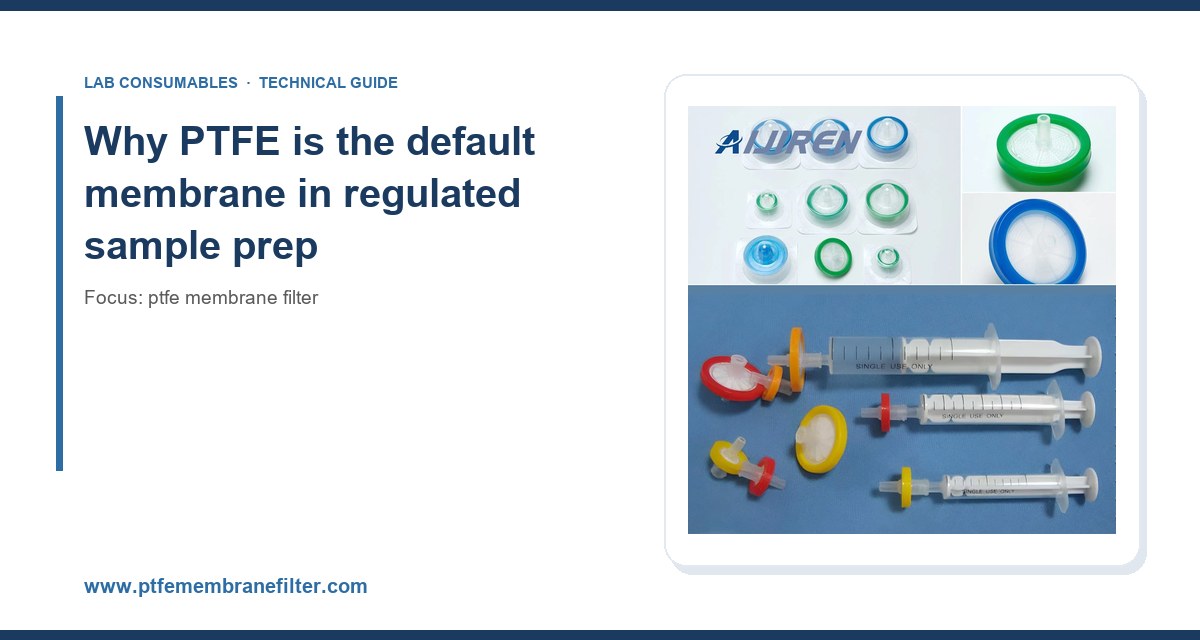
I lost three weeks of method validation time in 2019 because a lot of PTFE syringe filters I had approved for a metals-by-ICP prep step were silently shedding fine particulate into the digestate. The filters met the certificate of analysis. They were the right pore size and diameter. What they were not was the grade the regulated method actually assumed. That experience is the reason I now treat PTFE filter selection as a compliance decision, not a purchasing decision, and it is the reason this article exists.
If you are running an EPA, ISO, or AOAC method, the filter in your workflow is a controlled variable whether the method text names it or not. The wrong membrane can bias results, invalidate a calibration curve, or fail an audit. Here is what I have learned about specifying PTFE filters against regulated analytical methods, with the numbers and failure modes that matter.
Polytetrafluoroethylene is chemically inert across almost the entire solvent and acid range an analytical lab will encounter. It resists concentrated nitric acid, hydrochloric acid, sulfuric acid, hydrofluoric acid, trifluoroacetic acid, and most organic solvents. It does not wet easily, which is a nuisance for aqueous filtration but an advantage for gas and venting applications. It has a broad operating temperature range, typically -100 °C to +260 °C for the membrane itself, though the housing of a syringe filter sets the real working limit.
That combination is why PTFE shows up in three distinct roles in regulated methods:
- Particulate removal before instrumental analysis (ICP-OES, ICP-MS, ion chromatography, HPLC). The filter protects the column and the nebulizer from fines that would otherwise cause drift or clogging.
- Phase separation and clarification in extraction workflows where the solvent would dissolve or swell a cellulose or nylon membrane.
- Venting and gas filtration where the membrane must pass air or vapor but hold back liquid or aerosol.
Each role has different acceptance criteria. A filter that is perfect for venting a solvent reservoir is wrong for a 0.45 µm clarification step ahead of an HPLC column. The mistake I see most often is treating “PTFE” as a single specification when it is a family of membrane types (hydrophobic and hydrophilic, supported and unsupported, laminated) with very different behavior.
What the regulated methods actually require
No EPA, ISO, or AOAC method I have worked with specifies a brand of syringe filter. What they specify is a performance requirement (pore size, analyte recovery, blank contribution) and leave the consumable choice to the analyst, who then has to demonstrate fitness for purpose. That gap is where compliance problems live.
EPA SW-846 and the determinative step
SW-846 is the EPA’s compendium of test methods for evaluating solid waste, and many of its methods (3000-series for preparation, 6000 and 8000-series for determinative analysis) reference filtration as a sample-handling step without naming a membrane. The requirement that matters is in the quality control sections: method blanks, laboratory control samples, and matrix spikes must meet recovery and precision criteria. If your filter contributes analyte or adsorbs it, those QC samples fail and you have to find out why.
The practical guidance from U.S. EPA SW-846 test methods for waste and materials is to run a filter blank: pass the same volume of the same diluent through a filter from the same lot and analyze it alongside your samples. I do this for every new lot of PTFE filters that touches a metals or anion method. A clean filter blank should be below your method reporting limit for every target analyte. If a filter leaches more than 1 µg/L of a target metal into a 10 mL filtrate, it is not fit for that method and I reject the lot.
ISO methods and the pore-size question
ISO methods tend to be more explicit about the physical step. Water-quality methods under the ISO 5667 and 17294 families, for example, call for filtration through a 0.45 µm membrane for dissolved metals and often 0.22 µm for microbiological or particulate-sensitive work. The pore size is a defined part of the method, not a suggestion. Using a 0.45 µm filter where the method says 0.22 µm changes what you are calling “dissolved” and can shift results.
Pore size on a PTFE membrane is a nominal rating, not an absolute cutoff. A “0.45 µm” hydrophobic PTFE membrane will retain particles somewhat larger and somewhat smaller than 0.45 µm depending on the particle shape and the flow path. For most regulated work that is acceptable because the method was validated on nominal-rated membranes. Where it is not acceptable is in sterility testing and in methods that define a particulate count, and there you need to confirm the membrane’s absolute rating from the manufacturer’s data, not the catalog headline.
AOAC methods and recovery
AOAC Official Methods are validated against a specific procedure, and the filter is part of that procedure. When an AOAC method says to filter an extract before injection, the validation data behind the method assumed a particular membrane chemistry and a particular pore size. Substituting a different membrane without re-validating recovery is a deviation. I have seen labs do exactly that and then wonder why a spike recovery dropped from 98% to 82%.
The recovery risk is real for hydrophobic PTFE. Proteins, some pesticides, and certain semivolatile organics adsorb to the membrane surface. The smaller the filter diameter and the lower the load, the larger the relative loss. A 13 mm filter with 0.2 mL hold-up volume can retain a meaningful fraction of a dilute analyte. A 25 mm filter with 1 to 2 mL hold-up is usually safer for trace work, provided you discard the first portion of filtrate or account for the hold-up volume in your calculation.
Hydrophobic versus hydrophilic PTFE: pick the right one
Standard PTFE is hydrophobic. It will not pass water or aqueous buffers without a pressure differential high enough to overcome the surface tension, and even then it can be erratic. For aqueous sample prep you have two options: use a hydrophilic PTFE membrane (surface-modified to wet out) or use a different chemistry entirely.
This is where I see the most confusion. A procurement manager orders “PTFE syringe filters” for an aqueous method, the analyst cannot push water through them, and the lab ends up forcing them at high pressure, which can rupture the membrane and pass particulate straight through. The fix is to specify the wetting behavior explicitly on the purchase order.
Decision checklist for membrane selection
Use this as a specification sheet. The numbers are the ones I hold suppliers to.
- Aqueous sample, needs to wet out: hydrophilic PTFE, 0.22 µm or 0.45 µm, 25 mm diameter for volumes up to 100 mL. Confirm the membrane wets within 5 seconds of contact with water.
- Organic solvent or acid digest, hydrophobic is fine: hydrophobic PTFE, 0.45 µm, 13 mm for volumes under 10 mL, 25 mm above that. Pre-wet with a small volume of methanol or the sample solvent if the housing is dry.
- Gas or vent service: hydrophobic PTFE, 0.2 µm, unsupported membrane, rated to the housing pressure limit (typically 5 to 7 bar for a polypropylene housing).
- Trace metals: confirm the filter is certified low in the target elements. Reject any lot whose blank exceeds 1 µg/L per target metal in a 10 mL filtrate.
- HPLC injection prep: 0.45 µm hydrophobic or hydrophilic PTFE depending on solvent, 13 mm for 2 mL autosampler vials, and confirm hold-up volume is under 0.2 mL so you do not starve a 2 mL injection volume.
That last point connects directly to the vial you are filtering into. A 2 mL vial with a typical 1.5 mL working volume leaves little margin if your filter holds up 0.3 mL. If you are running small-volume methods, use a vial insert and size the filter to the insert volume, not the vial volume. I have watched analysts overfill inserts because the filter hold-up was never subtracted from the recovered volume.
Housing, hold-up, and the numbers that trip audits
The membrane gets the attention, but the housing is where a lot of regulated-method failures originate. A PTFE membrane in a polypropylene housing is the standard syringe filter construction. The polypropylene is chemically compatible with most solvents but not all, and it has a temperature limit far below the membrane’s 260 °C rating. Push a hot digest through a standard housing and you deform it.
Concrete specifications I require on the datasheet:
- Housing material: virgin polypropylene, no recycled resin, with a stated maximum operating temperature (usually 45 to 60 °C for standard units, higher for specialty housings).
- Hold-up volume: stated in µL for each diameter. A 13 mm unit should be under 100 µL; a 25 mm unit under 200 µL. If the supplier cannot state it, do not buy it for trace work.
- Burst pressure: typically 5 to 7 bar for a 25 mm unit. Exceeding it ruptures the membrane or blows the housing seal.
- Connections: female Luer lock inlet, male Luer slip or lock outlet. Luer fittings follow ISO 594 (now consolidated into ISO 80369 for some applications), and a sloppy Luer fit leaks under pressure. I check for a quarter-turn lock engagement and no wobble.
- Extractables: stated as a UV absorbance limit at 210 and 254 nm after a defined rinse. For HPLC prep, a filter that shows absorbance above 0.05 AU at 210 nm after a 5 mL rinse is suspect.
The extractables number is the one that most often goes unverified. I run a simple test: filter 5 mL of HPLC-grade water or mobile phase, inject 20 µL, and look for ghost peaks in the blank chromatogram. If the filter contributes peaks that co-elute with your analytes of interest, the method is compromised regardless of what the certificate says. This is the same discipline you would apply to a COD vial or any other consumable that touches the sample path.
Temperature, pressure, and the failure modes I have actually seen
PTFE is tough, but the assembly is not indestructible. The failures I have dealt with, in rough order of frequency:
Membrane rupture under over-pressure
An analyst cannot push a hydrophobic filter with a syringe, applies more force, and the membrane tears at the seal ring. The filter still passes liquid, so nothing looks wrong, but particulate and membrane fragments go straight into the vial. Symptom: sudden high particle counts or a column inlet frit that fouls within a few injections. Fix: match membrane wetting to the sample, and never exceed the rated burst pressure. If you need more than about 3 bar to push 10 mL through a 25 mm filter, something is wrong with the selection.
Housing deformation from hot liquids
Digests come off the hot block and get filtered too soon. A polypropylene housing softens above about 60 °C, the Luer seal deforms, and the filter leaks at the connection. Symptom: sample loss and a wet glove. Fix: cool digests to below 40 °C before filtration, or use a housing rated for the temperature. The membrane would survive 260 °C; the housing will not.
Analyte adsorption on hydrophobic PTFE
Trace organics and some metals adsorb to the hydrophobic surface. The loss is worst at low concentrations and small volumes. Symptom: spike recoveries drifting low, worse at the low end of the calibration curve. Fix: use the smallest membrane area that will pass the volume, pre-rinse with the sample solvent, and discard the first 0.5 mL of filtrate. For very low-level work, switch to hydrophilic PTFE or a different membrane and re-validate.
Particulate shedding from a poor lamination
This was my 2019 problem. A supported PTFE membrane with a weak laminate sheds fine fibers under flow. The certificate of analysis did not catch it because the test was a bubble-point, not a particle count. Symptom: inconsistent ICP results, nebulizer drift, and a filter blank that looks clean by absorbance but dirty by particle count. Fix: buy from suppliers who publish a particle-shedding specification, and run an effluent particle count on a new lot before releasing it to the method. A 0.45 µm filter should not shed particles above 2 µm at any meaningful count.
Compatibility with the rest of the sample path
A PTFE filter does not exist in isolation. It sits between the sample and the instrument, and it has to be compatible with everything it touches. Two practical points that come up in audits:
First, the solvent compatibility of the housing, not just the membrane. Polypropylene is fine for most aqueous and organic solvents but is attacked by some chlorinated solvents at elevated temperature and by strong oxidizing acids over time. Check the housing compatibility chart, not just the membrane chart.
Second, the connection to the downstream consumable. A filter that mates to a Luer syringe is fine for prep, but if you are filtering directly into an autosampler vial you need to confirm the outlet fits the vial opening without cross-threading. I have seen analysts force a Luer slip into a crimp vial and crack the neck. Match the outlet to the vessel. If you are working with a PTFE membrane filter for a specific vial format, confirm the dimensions before you commit the method.
For method development work, the chromatography suppliers publish useful compatibility and selection data. Agilent chromatography consumables and columns and Thermo Fisher chromatography and sample handling both maintain filter and vial selection guides that I have used to cross-check hold-up volumes and connection types. Restek technical resources for chromatography has application notes on filter effects on injection reproducibility that are worth reading before you lock a method.
Troubleshooting checklist for a failing regulated method
When a method that used to pass starts failing QC, work through this in order. It is faster than re-validating.
- Run a filter blank. Pass the same diluent through a filter from the current lot and analyze it. Compare to a blank with no filtration. Any target analyte above the method reporting limit points at the filter.
- Check the lot number. Membrane lots vary. If the failure started with a new box, suspect the box before you suspect the instrument.
- Measure the pressure to filter. If it takes more than 3 bar to push a standard volume, the membrane is wrong for the sample or is partially clogged. Both change the result.
- Inspect the filtrate for particles. A quick particle count or a visual against a light box will catch membrane shedding and rupture.
- Confirm wetting behavior. If the filter is hydrophobic and the sample is aqueous, the analyst may be forcing it. Check the procedure against the membrane spec.
- Verify hold-up volume against your calculation. If you did not subtract hold-up, your recovered volume is short and your concentration is high. This is a common and silent bias.
- Re-run a matrix spike through a fresh filter from a known-good lot. If recovery returns to the validated range, the filter was the cause.
I keep this checklist taped inside the sample-prep cabinet. It has saved more method investigations than any instrument service call.
What I recommend
For regulated analytical work, specify PTFE filters by grade, not by catalog description, and put the numbers on the purchase order. My standard specification for a general-purpose aqueous-and-acid sample prep filter is: hydrophilic PTFE membrane, 0.45 µm nominal, 25 mm diameter, virgin polypropylene housing rated to 60 °C, hold-up under 200 µL, female Luer lock inlet and male Luer slip outlet, with a published extractables limit below 0.05 AU at 210 nm and a filter-blank certification for the target analyte list. For organic and vent service, the same specification with a hydrophobic membrane and a 0.2 µm rating for gas.
Buy from a supplier who will give you the lot-specific blank data and the particle-shedding specification. If they will not, they are selling you a commodity filter, and a commodity filter is a compliance risk in a regulated method. The cost difference between a documented filter and an undocumented one is a few cents per unit. The cost of a failed method investigation is three weeks and a lot of explaining to an auditor.
One more thing. The filter is one component in a chain that includes the vial, the insert, the septa, and the instrument. Validate the chain, not just the filter. When a method passes with one combination of consumables and fails with another, the consumables are part of the method whether the written procedure names them or not. Treat them that way and the audits get a lot quieter.
References & further reading
Related resources from our lab consumables network:
- Ptfe Membrane Filter at ptfemembranefilter.com
- Cod Vial at codvial.com
- Vial Insert at hplcinsert.com
- 2Ml Vial at 2mlsamplevial.com
External references and standards: